

♥ Wishlist
Compare 35 verified Dewalt Cordless Impact Wrenches products in United Kingdom. Reviews, ratings, pros, cons and buying advice updated for October 2026.


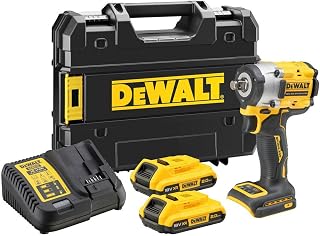


Choosing a DEWALT cordless impact wrench is not simply a matter of selecting the model with the highest quoted torque figure. The right tool depends on the type of fasteners you work with, the available working space, how frequently the wrench will be used, the battery platform you already own, and whether portability or maximum fastening performance is the priority.
For UK buyers, it is also worth considering the practical differences between compact, mid-torque and high-torque impact wrenches. A compact wrench can be easier to use around suspension components and confined spaces, while a larger high-torque model may be more appropriate for demanding mechanical work where stubborn fasteners require substantially more capability.
DEWALT has a broad cordless tool ecosystem, so buyers who already own compatible DEWALT batteries may find a bare-tool purchase particularly relevant. However, battery compatibility should always be checked against the exact model rather than assumed from the brand name alone.
Torque is one of the most important specifications when comparing cordless impact wrenches, but it is also one of the easiest to misunderstand. Manufacturers may publish several different torque figures, and those figures can describe different operating conditions or functions.
When comparing products, look for clearly identified specifications rather than relying on a single headline number. A tool marketed with a very high maximum torque figure is not automatically the best choice for every job.
Maximum fastening torque indicates the tool's potential output under specified conditions. It can be useful when determining whether an impact wrench has enough capacity for demanding applications, but it should not be treated as a guaranteed torque value for every fastener.
Breakaway performance relates to loosening fasteners that are already tightened or seized. This can be particularly relevant for automotive maintenance, machinery repair and outdoor equipment where corrosion, contamination or previous over-tightening may make removal difficult.
More torque is not always better. Excessive impact output can damage fasteners, threads or components if the tool is used without appropriate control. For critical assemblies, an impact wrench should generally be regarded as a fitting or removal tool rather than a substitute for a calibrated torque wrench when a specified final torque is required.
The most useful way to narrow down the DEWALT range is to identify the class of impact wrench that matches the work you actually perform.
Compact models are designed around accessibility and manoeuvrability. Their smaller dimensions can make them useful in engine bays, wheel arches, workshops, construction environments and other locations where a long tool body becomes awkward.
Mid-torque tools can provide a useful balance between physical size and fastening capability. They are worth considering for buyers who need more versatility than a compact wrench provides but do not regularly encounter the most demanding heavy-duty fasteners.
High-torque models are aimed at applications where substantial loosening or fastening capability is important. They can be particularly relevant to professional mechanical work, larger machinery and demanding maintenance tasks.
Battery selection can have a noticeable effect on the overall experience of using a cordless impact wrench. Buyers should check the exact battery platform specified for their chosen wrench and then consider capacity, physical size, weight and expected workload.
A higher-capacity battery can provide more operating time between charges, but it may also increase the weight and bulk of the complete tool. For overhead work or repeated use throughout a working day, the balance between runtime and ergonomics can matter as much as headline battery capacity.
A bare-tool package can make sense for existing DEWALT users who already have compatible batteries and a suitable charger. It avoids paying for duplicate batteries and charging equipment.
A complete kit may be more appropriate for someone entering the cordless platform for the first time. Before choosing, compare the contents of the exact package rather than assuming that every listing for the same tool includes the same accessories.
DEWALT has produced multiple cordless systems and battery technologies over time. Do not purchase a battery based solely on the DEWALT name. Confirm the exact battery family and compatibility information for the impact wrench you intend to buy.
Brushless motor technology is an important consideration in modern cordless power tools. A brushless motor eliminates conventional motor brushes, allowing the tool's electronic control system to manage power delivery and motor operation without the same brush arrangement used in brushed designs.
For an impact wrench, buyers should consider brushless technology alongside the complete specification rather than treating it as the only measure of quality. Motor design, electronic controls, gearing, impact mechanism, battery technology and thermal management all contribute to the overall tool.
An impact wrench does not simply apply continuous rotary force in the same way as a conventional drill or driver. Its impact mechanism delivers repeated hammering action that can help loosen or tighten high-resistance fasteners.
The impact mechanism is therefore central to the tool's performance. However, a specification sheet cannot tell the entire story. Ergonomics, trigger response, speed control, electronic modes and the tool's behaviour under load can all influence how easy it is to work accurately.
Different jobs can require different levels of impact. A tool with selectable speed or control modes can be more versatile than one that simply operates at maximum output.
Drive size is an important specification because it affects socket compatibility and the types of fastening jobs for which the tool is most convenient.
Small-drive impact tools are commonly associated with lighter fastening applications and compact sockets. Buyers should distinguish between an impact driver using a hex interface and an impact wrench using a square drive, because the two tools are designed around different accessory systems.
A 3/8-inch square drive can be a useful choice for lighter mechanical work and applications where access and relatively small sockets are important.
A 1/2-inch drive is widely associated with automotive and general mechanical work. It provides compatibility with a broad range of commonly used impact sockets and can be appropriate where larger fasteners are involved.
The correct drive size should be selected according to the sockets and fasteners you use rather than simply choosing the largest available option.
One common buying mistake is treating an impact wrench and impact driver as interchangeable tools. Although both use impact mechanisms, they are designed for different accessory systems and applications.
An impact driver generally uses a hexagonal bit interface and is commonly selected for screws, construction fasteners and other driving tasks. An impact wrench normally uses a square drive designed for sockets and is better suited to nuts and bolts.
If your primary requirement is wheel nuts, automotive fasteners or mechanical sockets, an impact wrench is usually the more appropriate category to investigate. If your work centres on screws and construction fixings, an impact driver may be the better tool.
Power specifications receive considerable attention in buying guides, but ergonomics can determine whether a powerful tool is genuinely useful during long working sessions.
Consider the complete tool with its battery attached. A specification that looks attractive on paper can feel very different when the tool is repeatedly held at shoulder height or used in a confined area.
Pay attention to where the motor, gearbox and battery sit in relation to the handle. A well-balanced tool can feel easier to control than a tool with similar total weight but less favourable weight distribution.
The handle should allow a secure grip while wearing the type of gloves appropriate to the job. Trigger placement and variable-speed control are also important because they affect how easily the operator can start and stop the tool.
Overall length can be more important than total weight when working around suspension components, machinery frames or other obstructions. A slightly longer tool may be powerful but impossible to position effectively in a restricted space.
Once torque and battery compatibility have been established, compare the features that affect day-to-day usability.
Automotive users should think beyond maximum torque. Wheel nuts, suspension fasteners, engine components and general service work can involve different access requirements and different levels of fastening resistance.
For routine vehicle maintenance, a compact or mid-torque wrench may provide a more convenient balance than the largest high-output model. For heavier mechanical work, a high-torque model may be more appropriate if the physical size and weight are acceptable.
Regardless of the tool selected, critical wheel and suspension fasteners should be tightened to the vehicle manufacturer's specified torque using an appropriate calibrated torque wrench where required. An impact wrench's maximum output is not a substitute for the vehicle manufacturer's fastening specification.
Construction professionals may use impact wrenches for structural fixings, machinery installation, heavy-duty fastening and maintenance. In these environments, durability and battery management can become particularly important.
Tradespeople should consider how frequently the wrench will be carried between locations, whether it needs to fit inside tool storage, how many batteries are already available and whether the job regularly involves confined access.
A compact model can be preferable when portability is critical, while a higher-output model can be justified when the work consistently involves large or stubborn fasteners.
DEWALT is not the only established manufacturer in the cordless power-tool market. Buyers comparing impact wrenches may also encounter ranges from Makita, Milwaukee, Bosch Professional and HiKOKI.
The most useful comparison is not simply brand versus brand. Compare the specific tool class, battery ecosystem, drive size, dimensions, weight, control features, included accessories and manufacturer specifications.
For buyers already invested in either cordless ecosystem, battery compatibility can be an important deciding factor. Compare the exact tool and battery platform rather than assuming that one brand is universally better.
Milwaukee offers a substantial range of cordless professional tools, including different impact wrench classes. When comparing Milwaukee with DEWALT, focus on the equivalent torque category and physical design rather than comparing headline specifications from different tool classes.
Bosch Professional is another established option for buyers who want to build around a particular professional cordless system. Battery-platform compatibility, local availability and the type of tools already owned can all influence the better choice.
HiKOKI also produces cordless impact tools aimed at professional and demanding users. As with other comparisons, the exact model specifications should be checked because output, dimensions, battery requirements and included equipment can differ substantially within a manufacturer's range.
Maximum output can look impressive, but a large high-torque wrench may be unnecessarily bulky for routine jobs. Choose the smallest tool that comfortably meets the requirements of your typical work.
A cordless tool is only as convenient as its battery setup. Verify the compatible battery family before purchasing a bare tool or additional batteries.
Do not assume that two manufacturers' published torque figures represent identical testing conditions. Read the terminology and specification details carefully.
Impact wrenches should be used with accessories suitable for impact applications. Standard non-impact sockets are not automatically appropriate for high-load impact use.
Customer reviews can help identify recurring usability concerns, but reviews should be considered alongside official specifications, intended application, battery requirements and the needs of the buyer.
Impact wrenches are designed to deliver rapid fastening and loosening performance. Where an exact final torque is specified, use the appropriate calibrated torque-control equipment according to the relevant manufacturer's instructions.
Before buying, create a short comparison checklist rather than relying on the product title alone.
When comparing listings from UK retailers, make sure you are comparing like-for-like packages. The same basic tool can sometimes be offered as a bare unit, a kit with one battery, a kit with multiple batteries or a package containing additional accessories.
Check the exact model number and included contents before comparing prices. A lower headline price may represent a bare tool, while a higher-priced listing may include batteries and charging equipment.
Also check whether the retailer identifies the product as a UK-market item and review the stated warranty and returns information before purchase. These details should be verified on the retailer's current listing because terms can change.
Customer reviews can be useful when interpreted carefully. Instead of focusing only on the overall rating, look for recurring comments about specific characteristics relevant to your work.
Individual reviews should not be treated as controlled product tests. A professional mechanic using a wrench every day has different requirements from a homeowner who uses one occasionally, so review relevance matters.
Proper maintenance can help preserve the condition and usability of a cordless impact wrench. Always follow the manufacturer's instructions for the exact model.
Impact sockets are designed to tolerate the repeated shock loading associated with impact tools. Their construction and material properties differ from many conventional hand-tool sockets.
Using the correct socket is particularly important when an impact wrench is operated at high output. Check the socket manufacturer's compatibility information and replace accessories that show significant damage, deformation or excessive wear.
Socket size should also match the fastener accurately. A poorly fitting socket can increase the risk of rounding the fastener and can make removal more difficult.
Impact wrenches are powerful tools and should be used with appropriate personal protective equipment and safe working practices.
A DEWALT cordless impact wrench can be a compelling option for buyers who value cordless mobility, established tool-platform compatibility and the convenience of socket-based power fastening. Whether a particular model represents good value depends on its specifications, package contents and suitability for the intended work.
For occasional DIY users, buying a large high-output model may provide more capability than necessary. For professional users who regularly remove stubborn fasteners, investing in an appropriate higher-performance model may be more rational.
The best choice is therefore the model that provides sufficient output without introducing unnecessary weight, size or cost.
Not every buyer needs maximum impact performance. If most of your work involves small screws, light-duty fasteners or precision fastening, a drill, driver or smaller impact tool may be more appropriate.
Likewise, users who only occasionally remove wheel nuts may not need a large professional-grade wrench if a smaller model adequately meets their requirements. The best buying decision should reflect actual use rather than the maximum capability available.
There is no single best DEWALT cordless impact wrench for every UK buyer. The appropriate model depends on required torque, drive size, working space, battery platform, weight tolerance and frequency of use. Compact models can prioritise access and portability, while high-torque models are better suited to demanding fastening and removal work.
Suitable DEWALT impact wrenches can be useful for removing and initially fitting wheel fasteners, provided the tool has the appropriate drive and capability. Final wheel-fastener tightening should follow the vehicle manufacturer's specified torque procedure and should not rely solely on an impact wrench's maximum output.
A bare tool can be a sensible choice if you already own compatible DEWALT batteries and a charger. If you do not have the required battery system, compare the cost of a complete kit with the cost of buying the battery and charger separately.
No. Higher torque can be valuable for difficult fasteners, but a more powerful wrench may also be larger, heavier and less convenient for routine work. Excessive fastening force can also be inappropriate for components with specified torque requirements.
Choose the drive size that matches the sockets and fasteners you commonly use. A 1/2-inch drive is a common choice for many automotive and general mechanical applications, while smaller drives can be preferable where lighter fastening and improved access are priorities.
An impact wrench should not automatically be treated as a replacement for a calibrated torque wrench when a precise final torque is specified. Use the appropriate torque-control method required by the vehicle, machinery or component manufacturer.
Brushless motor technology can provide important advantages in modern cordless tools, but the best purchase still depends on the complete tool design. Consider the motor, impact mechanism, control system, battery platform, dimensions, weight and intended application together.
Compare the exact model specifications, including drive size, published torque figures, speed, control modes, dimensions, weight, battery compatibility and included accessories. Then consider whether each model is appropriate for the fasteners and working conditions you actually encounter.
DEWALT produces cordless impact wrenches across different performance categories, including tools aimed at demanding users. Professional buyers should select the specific model according to workload, fastening requirements, ergonomics, battery availability and manufacturer specifications.
Check the exact model number, package contents, battery configuration, drive size, current specification details, retailer warranty terms, returns policy and current price. Comparing like-for-like packages prevents a bare tool from being mistakenly compared with a complete kit.
The strongest way to choose among top-rated DEWALT cordless impact wrenches in the UK is to start with the work rather than the marketing headline. Determine the fastener sizes you encounter, the required level of loosening capability, the available working space and whether you already own compatible DEWALT batteries.
From there, compare the exact specifications and package contents of shortlisted models. Give appropriate weight to torque, but also examine drive size, dimensions, weight, control options, battery compatibility and ergonomics. Customer feedback can provide additional context, but it should complement rather than replace manufacturer specifications and application-specific requirements.
For buyers who already use DEWALT cordless tools, platform compatibility may make the decision particularly straightforward. For new buyers, compare the wider cordless ecosystem as well as the impact wrench itself. A tool that fits naturally into your existing or planned collection can offer considerably more practical value than a model selected purely for its maximum torque figure.