

♥ Wishlist
Compare 48 verified DeWalt Battery and Charger products in United Kingdom. Reviews, ratings, pros, cons and buying advice updated for October 2026.


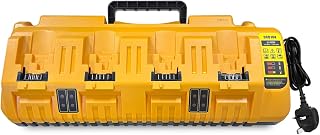


Choosing a Dewalt battery and charger is less about simply selecting the largest battery capacity and more about matching the battery platform, voltage, capacity, charger type and intended workload. For UK buyers, the most important first step is to identify the cordless tool platform you already own. A battery designed for one Dewalt voltage family should not be assumed to work with another simply because the packs look similar.
Dewalt's cordless range includes compact batteries intended for drills and impact drivers, higher-capacity packs for saws and grinders, and advanced battery technologies designed to provide greater power for demanding applications. The charger also matters because charging speed, compatibility and charging management can differ between models.
Before buying, check the exact battery and charger requirements stated for your tool. Look at the voltage, battery series, model compatibility and charger specifications rather than relying on photographs or general descriptions. This is particularly important when buying through marketplaces, where similarly named battery packs can have substantially different specifications.
Voltage is one of the most important compatibility factors. Dewalt sells cordless tools across several voltage platforms, and a higher-voltage battery is not automatically a suitable upgrade for a lower-voltage tool.
For example, Dewalt's XR cordless ecosystem includes 18V tools, while the company's FLEXVOLT system is designed around batteries capable of supporting compatible higher-voltage applications while also offering compatibility with selected 18V XR tools. However, compatibility must always be checked against the individual tool and battery model.
Never select a battery solely because its voltage appears close to the requirement. Use the manufacturer's compatibility information for the specific tool.
Battery capacity is commonly expressed in ampere-hours, or Ah. In simple terms, a higher Ah rating generally indicates greater stored electrical capacity and can provide longer runtime under comparable conditions. It does not mean that a higher-Ah battery will automatically make every compatible tool perform proportionally better.
A compact battery may be preferable for drilling overhead, assembling furniture or working in confined areas. A larger battery can make more sense for cutting timber, grinding, demolition or other applications that consume energy rapidly.
The correct capacity depends on the job. If a drill is normally used for short bursts, carrying the largest available pack may provide little practical benefit. If a cordless saw is being used continuously away from a mains supply, additional capacity can be much more valuable.
Battery weight is often overlooked when comparing specifications. A battery is physically attached to the tool, so its mass affects how the complete tool feels during use.
A high-capacity pack may increase runtime while also making a compact drill or impact driver feel noticeably heavier. This can matter when working overhead, climbing ladders, installing fixings repeatedly or performing detailed work for extended periods.
Consider the complete tool-and-battery combination rather than evaluating the battery in isolation. For repetitive light-duty work, a smaller pack can sometimes be the more practical choice even when a larger battery offers greater capacity.
Dewalt XR and FLEXVOLT are related cordless systems, but they should not be treated as interchangeable product labels.
XR batteries are associated with Dewalt's established cordless tool platform and are available in different capacities. FLEXVOLT batteries incorporate voltage-switching technology intended for compatible Dewalt tools, allowing certain packs to operate at different voltage levels depending on the equipment in which they are used.
This distinction is especially important when purchasing a replacement battery for a professional tool. Check the exact battery model and the tool manufacturer's compatibility information before ordering. Do not assume that every FLEXVOLT battery can be used with every Dewalt cordless product.
The charger should be selected with the same care as the battery. A charger must be compatible with the relevant Dewalt battery system, and buyers should consider charging speed, portability and the number of batteries they typically use during a working day.
A basic charger can be perfectly adequate for occasional DIY use when there is plenty of time between jobs. A faster charger becomes more attractive when several tools are being used throughout the day and battery downtime can interrupt work.
Charging speed should not be considered in isolation. The battery's capacity, the charger model and the manufacturer's stated charging characteristics all affect how quickly a particular pack can be replenished.
If you already own compatible Dewalt batteries, purchasing a charger on its own can avoid paying for another battery you do not need. On the other hand, someone building a cordless tool collection from scratch may find a battery-and-charger kit more convenient.
Compare the contents carefully. A product described as a battery kit may contain one battery, multiple batteries, a charger or other accessories. Product photographs should not be treated as a substitute for checking the written contents and model numbers.
Battery packs are a category where specification checking is particularly important. An unusually cheap replacement can look similar to a genuine product while differing in cell configuration, electronics, protection systems, capacity or construction.
For users who depend on cordless tools for regular work, a genuine Dewalt battery can provide the clearest route to maintaining compatibility with the manufacturer's cordless ecosystem. Buyers considering third-party replacements should carefully examine compatibility claims, electrical specifications, protection features and retailer information rather than choosing purely on price.
Be particularly cautious about listings that make unusually large capacity claims without providing clear technical information. A claimed Ah figure should be assessed alongside the battery's voltage, physical configuration, stated specifications and seller credibility.
Modern cordless tool batteries are more than collections of individual cells. Battery packs incorporate electronic systems that can monitor operating conditions and communicate with compatible tools and chargers.
These systems can influence charging, protection and the way the battery interacts with the tool. This is another reason why physical fit alone is not enough to establish compatibility.
When comparing batteries, look beyond the Ah figure. The battery platform, electronics, intended applications and manufacturer's compatibility information can be just as important.
There is no single runtime figure that applies to every application. The same battery can deliver substantially different working time depending on the tool and task.
A drill used intermittently for pilot holes may consume considerably less energy than a grinder running continuously under load. For that reason, advertised capacity should be used as a comparison specification rather than interpreted as a guaranteed number of minutes of operation.
For occasional DIY work, portability can be more important than maximum capacity. A compact battery can make drills and impact drivers easier to handle while still providing enough energy for short projects.
If your DIY work includes long periods of cutting, sanding or drilling, a mid-capacity battery can offer a useful compromise. If you regularly undertake large renovation projects, having two or more compatible batteries can be more convenient than relying on one high-capacity pack.
Professional users should consider the complete workflow rather than simply selecting the battery with the highest Ah rating.
Think about how many cordless tools are used simultaneously, how long each tool is operated, whether mains electricity is readily available and how quickly batteries can be recharged. A combination of compact and high-capacity packs can be more versatile than purchasing identical batteries for every tool.
For high-demand equipment, verify whether the tool specifically recommends or requires a particular Dewalt battery technology. High-output applications can place substantially greater demands on the battery than light drilling or screwdriving.
Buying multiple batteries can make a cordless tool collection considerably more practical. Instead of stopping work whenever one battery is depleted, one pack can be used while another is charging.
There is no universal ideal number. Consider the number of tools, their power demands, the duration of typical jobs and the charging facilities available.
Proper storage can help maintain a rechargeable battery in good condition. Follow Dewalt's instructions for the specific battery rather than relying on generic battery advice, particularly when storing batteries for extended periods.
Rechargeable batteries naturally lose capacity over their service life. A pack that once powered a tool for a substantial period may eventually require more frequent charging.
Possible signs of deterioration include noticeably reduced runtime, unusual behaviour during charging, physical damage or other conditions identified in the manufacturer's safety guidance. A battery should not be opened or modified by the user. If a pack appears damaged, discontinue use and follow the manufacturer's safety and disposal guidance.
Battery charging should always follow the instructions supplied by the manufacturer. Use the correct compatible charger and place the charging equipment in an appropriate environment.
Do not attempt to modify battery packs, bypass protection electronics or combine incompatible batteries and chargers. Lithium-ion battery packs contain stored energy, so damaged or improperly handled packs can present serious safety risks.
Before buying a charger, verify its compatibility with the exact battery family you intend to charge. The safest approach is to use manufacturer's specifications rather than assuming that a connector or physical interface guarantees compatibility.
Dewalt is one of several established power-tool brands competing in the UK cordless market. Depending on the tools you already own, it can also be useful to compare its battery ecosystem with systems from brands such as Makita, Bosch Professional and Milwaukee.
The most important comparison is not simply which brand has the biggest battery. Instead, examine the complete ecosystem: compatible tools, battery capacities, charger options, tool availability, ergonomics, specialist equipment and the cost of expanding the collection.
Battery ecosystems are generally most valuable when they allow one compatible battery family to support many tools. If you already own several tools from one platform, staying within that ecosystem can simplify charging and battery management.
A larger battery can provide greater capacity, but it can also increase weight and change the balance of a handheld tool. Choose capacity according to the application.
Voltage should be confirmed before purchase. Do not assume that batteries can be interchanged between different Dewalt systems simply because they use similar physical connections.
The cheapest listing is not necessarily the best value. Compare the exact model, capacity, compatibility, seller information and included items.
Check whether the package includes a charger. Product titles can use terms such as kit, bundle or twin pack differently, so inspect the stated contents before purchasing.
For handheld tools, a lighter battery can sometimes make a bigger difference to comfort than an additional few ampere-hours.
FLEXVOLT compatibility depends on the particular tool and battery configuration. Always check the manufacturer's compatibility information.
When comparing deals, calculate the value of the complete package rather than comparing headline prices alone. A lower-priced battery may have less capacity, while a seemingly expensive kit may include additional batteries or a charger.
A bundle can be convenient when starting or expanding a cordless collection, but buying separately may make more sense when you already have compatible batteries or chargers.
For example, a user with several batteries but only one charger may benefit more from an additional compatible charger than another battery. Conversely, someone purchasing their first Dewalt cordless tool may prefer a complete battery-and-charger package.
Product titles can contain a large amount of information, so separate the important specifications from marketing language. Look for the manufacturer's model designation, voltage, Ah rating, battery technology and stated compatibility.
Also distinguish between the battery model and the charger model. A listing may mention several compatible tools, but this does not necessarily mean every Dewalt tool is compatible with that battery.
When buying from a UK retailer or marketplace, check the full specification section and package contents before adding the product to your basket. If the description is inconsistent, incomplete or unclear about the exact model, it is sensible to investigate further before purchasing.
A balanced battery collection can be more useful than buying only the largest packs. Compact batteries are convenient for drills and impact drivers, while higher-capacity packs can be reserved for equipment that consumes energy quickly.
As the collection grows, consider standardising around compatible batteries wherever practical. This reduces the number of different chargers required and makes it easier to rotate batteries between tools.
For users with a mixture of everyday and high-demand tools, a combination of smaller XR batteries and suitable higher-capacity or FLEXVOLT batteries may provide greater flexibility than using one battery size for everything.
A high-capacity battery is less compelling when the primary tools are lightweight drills, screwdrivers or inspection equipment used only intermittently.
Compact batteries are not simply an entry-level option. They can be the better choice whenever ergonomics and handling are more important than maximum stored energy.
The initial battery price is only one part of the long-term cost of a cordless tool ecosystem. Buyers should also consider how many batteries they are likely to need, whether existing chargers remain useful, and how easily additional compatible tools can be added later.
A platform that supports many of the tools you expect to use can reduce duplication over time because the same battery family may serve several compatible products. This can make the battery ecosystem an important consideration when deciding between cordless tool brands.
UK buyers should pay attention to the exact product supplied, retailer information and electrical specifications. Check that the charger is suitable for the UK market and that the product description clearly identifies the relevant model.
When comparing online offers, consider the total package rather than the headline discount. Availability and pricing can change, so current retailer information should be checked immediately before purchase.
No. Dewalt has multiple battery platforms and tool specifications. Compatibility must be checked for the exact tool and battery combination.
No. Higher capacity can provide longer runtime, but it can also increase battery weight. A compact battery may be more suitable for lightweight or repetitive work.
No. They are related Dewalt cordless technologies with different characteristics. FLEXVOLT batteries are designed to support compatible applications that can include different voltage configurations. Check the specific tool and battery compatibility information before buying.
Two batteries can be useful when continuous work is expected because one can be used while another is charged. The best configuration depends on the tools being operated and the duration of typical jobs.
Not necessarily. Battery capacity and voltage are different specifications. Some high-performance tools are designed to take advantage of particular battery technologies, but simply choosing a larger Ah pack does not mean every compatible tool will deliver proportionally more power.
Charging time depends on the battery capacity, charger model and charging system. Check the manufacturer's specifications for the particular battery and charger rather than relying on a generic charging-time estimate.
Follow Dewalt's instructions for the specific battery and charger. Use the manufacturer's recommended charging and storage practices rather than assuming that all rechargeable battery systems should be treated identically.
There is no universal best capacity. Compact drills often benefit from lighter batteries, while users performing extended drilling may prefer greater capacity. Consider the drill's size, working position, frequency of use and required runtime.
A circular saw can consume substantially more energy than a compact drill, particularly during repeated cutting. A higher-capacity or otherwise suitable high-performance battery can therefore be more practical, provided it is compatible with the particular saw.
They can appear attractive on price, but buyers should carefully verify compatibility, electrical specifications, protection features, capacity claims and seller credibility. For important or demanding applications, using a battery specified by the tool manufacturer can reduce compatibility uncertainty.
Check the exact product identification, packaging, specifications and retailer information. Be cautious with listings that use unclear model numbers, unusually low pricing or unsupported capacity claims. When authenticity matters, purchasing through an established retailer can make verification easier.
Do not assume that batteries can safely or correctly be used across different manufacturers' platforms. Battery interfaces, electronics and protection systems can differ even when voltage ratings appear similar.
Before choosing a Dewalt battery and charger, work through the following checklist:
The best Dewalt battery and charger combination is the one that matches the cordless tools you actually use. Compatibility should come first, followed by capacity, weight, charging speed and overall value. A high-capacity battery can be an excellent choice for demanding equipment, while a compact pack may be better for everyday drilling and fastening.
For buyers building a larger cordless collection, the battery platform deserves particular attention. Staying within a compatible Dewalt ecosystem can make future tool purchases simpler, while having a sensible mixture of battery capacities can provide a better balance of runtime and handling.
Before purchasing, compare the exact specifications, confirm compatibility with your tool, review the package contents and check current UK retailer information. That approach is more reliable than choosing solely on Ah capacity, headline discounts or product photographs.