

♥ Wishlist
Compare 23 verified Einhell Battery And Charger products in United Kingdom. Reviews, ratings, pros, cons and buying advice updated for October 2026.


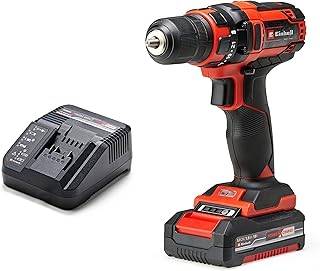


Choosing an Einhell battery and charger is less about finding the battery with the largest capacity and more about matching the battery, charger and Power X-Change tool to the way you actually work. A homeowner who uses a drill occasionally has very different requirements from someone regularly cutting timber, mowing a large garden or using a high-demand cordless saw.
For UK buyers, the most important starting point is compatibility. Einhell's Power X-Change system is designed around a shared battery platform, allowing compatible cordless tools to use the same battery family. Before buying, check the exact tool and battery specifications rather than relying on appearance alone. A battery that physically fits is not necessarily the right choice for every application or kit configuration.
It is also worth considering the complete charging setup. Battery capacity affects runtime and weight, while charger type affects how quickly a depleted battery can be returned to service. If several Power X-Change tools are already part of your workshop or garden equipment, buying additional batteries within the same ecosystem can be more practical than maintaining several incompatible battery platforms.
The Power X-Change platform is central to Einhell's cordless tool range. Instead of purchasing a dedicated battery for every individual tool, compatible equipment can share batteries from the same system. This can simplify a growing tool collection and make it easier to keep a spare battery available while another is charging.
However, shared-platform compatibility should not be confused with identical performance. Different batteries can have substantially different capacities, dimensions, weights and intended applications. The best option therefore depends on the tool and workload rather than simply the highest Ah rating.
Ah means ampere-hours and is commonly used to describe battery capacity. In practical terms, a higher Ah rating generally means more stored energy and the potential for longer runtime, although actual runtime varies according to the tool, workload, material, operating conditions and battery technology.
For example, a compact battery can make sense for light drilling, driving screws or short jobs where low weight is particularly useful. A higher-capacity battery may be preferable for equipment that operates continuously or draws considerably more power, such as certain saws, grinders, lawn mowers and garden machinery.
Battery capacity is only one part of the buying decision. A larger battery can add noticeable weight to a cordless drill, impact driver, hedge trimmer or other handheld tool. That additional weight may be worthwhile for extended runtime, but it can become tiring during overhead work or prolonged use.
For handheld tools, consider how the battery changes the overall balance of the machine. A compact battery can make a drill or driver easier to manoeuvre in confined spaces, whereas a higher-capacity battery may be more appropriate when maximum runtime is more important than portability.
The charger should be treated as part of the battery system rather than an afterthought. A suitable charger must be compatible with the relevant Einhell battery platform and should be selected according to how frequently you use your tools and how quickly you need batteries ready for the next job.
For occasional DIY use, a conventional charger may be perfectly adequate. If a battery is charged overnight or between infrequent projects, there may be little practical benefit in paying more for the fastest charging option.
Frequent users have different priorities. If cordless tools are used throughout the day, faster charging can reduce downtime, particularly when several tools depend on the same battery platform. The appropriate choice depends on the specific battery and charger combination, so check the manufacturer's stated charging characteristics before purchasing.
If you are entering the Power X-Change ecosystem for the first time, a battery-and-charger starter kit can be more convenient than buying the components separately. A kit can also reduce the risk of accidentally selecting an unsuitable charger or forgetting one of the essential components.
Existing Power X-Change users may have the opposite requirement. If a compatible charger is already available, buying a battery on its own may be the more economical way to expand the collection. Always check exactly what is included in the listing because product bundles can differ in battery capacity, charger type and accessories.
There is no universally best Einhell battery capacity. The correct choice depends on the balance between runtime, weight, price and the electrical demands of the tool.
Compact and mid-capacity batteries can be particularly convenient for drills and drivers because these tools are frequently used one-handed and moved between different positions. For furniture assembly, shelving, light maintenance and general DIY, a lighter battery can make repeated fastening work more comfortable.
For heavier drilling or fastening, a larger battery may provide a more useful combination of runtime and sustained performance. The tool's own specifications should remain the deciding factor.
Saws can place greater demands on a battery because cutting resistance varies significantly with the material, blade condition and depth of cut. If a cordless saw is being used for repeated cuts, runtime can become more important than minimum weight.
Consider the type of material being cut, the number of cuts normally required and whether spare batteries are available. A second compatible battery can be particularly useful for longer projects.
High-demand cordless tools can consume battery energy relatively quickly, especially when operated under substantial load. In these situations, battery capacity and thermal management deserve more attention than they would for intermittent low-load tasks.
Do not assume that the highest-capacity battery is automatically the best purchase. Compare the battery's physical size, weight, cost and compatibility with the tool before making a decision.
Battery selection becomes particularly important for cordless lawn mowers, strimmers, hedge trimmers, blowers and similar equipment. Garden tools may be operated continuously for much longer periods than a drill, making runtime a major consideration.
For larger gardens or lengthy sessions, having multiple compatible batteries can be more practical than relying on a single battery. For smaller maintenance tasks, a lighter battery may provide a better overall experience.
Battery runtime cannot be predicted from Ah capacity alone. A cordless drill used intermittently to drive screws consumes energy very differently from a saw cutting dense timber or a blower operating continuously.
Load is one of the biggest variables. When a tool encounters greater resistance, the motor may draw more power. Material, blade or accessory condition, technique, ambient temperature and operating duration can all influence how quickly energy is consumed.
This is why manufacturer runtime claims, where provided, should be treated as application-specific guidance rather than a guarantee that every tool will operate for the same length of time.
When comparing cordless batteries, avoid looking at Ah in isolation. Voltage and capacity describe different aspects of the battery system. Capacity is commonly expressed in ampere-hours, while voltage relates to the electrical potential of the battery pack.
A useful way to understand stored energy is through watt-hours, calculated approximately as voltage multiplied by ampere-hours. This can make comparisons between batteries easier when their voltage and capacity specifications are both known. Nevertheless, real-world runtime still depends on the tool and operating conditions.
Modern cordless power tools commonly rely on lithium-ion battery technology because it offers a useful combination of energy density, rechargeability and relatively low weight. The battery management electronics are also important because modern battery packs incorporate protection and monitoring systems rather than functioning as simple collections of cells.
For buyers, this means the battery and charger should be regarded as a matched system. Use the charger specified for the relevant battery platform and follow the manufacturer's operating, charging and storage instructions.
A good buying decision should account for more than headline capacity. Use the following checklist when comparing options:
The highest Ah rating is not necessarily the best option. Extra capacity can add weight and cost, and that trade-off may not be worthwhile for occasional DIY tasks.
A battery is only useful when it can be charged appropriately. Buyers purchasing a battery separately should confirm that they already own a suitable charger or budget for one.
A very low purchase price can be attractive, but compare what is actually included. A battery-only listing may look cheaper than a bundle while providing considerably less equipment.
Names and product descriptions can look similar across a large cordless-tool range. Check the manufacturer's product information and the retailer listing carefully, particularly when comparing battery capacity, charger type and package contents.
Battery weight becomes increasingly noticeable during repetitive work. A battery that is ideal for a lawn mower may be unnecessarily bulky for a compact drill.
This is one of the most useful decisions for buyers building a cordless tool collection. One high-capacity battery can provide long runtime, but it also means the entire system depends on that single pack while it is being used or charged.
Several batteries provide flexibility. One can remain on the charger while another is attached to a tool, making it easier to continue working. Multiple batteries can also allow different tools to be configured with capacities appropriate to their applications.
The best arrangement depends on usage frequency, the number of compatible tools and whether your projects typically involve short tasks or extended periods of continuous operation.
If you are gradually expanding a cordless tool collection, start by identifying your highest-frequency tools. A sensible setup might prioritise a battery for everyday handheld equipment and then add higher-capacity packs when larger garden or workshop tools require more runtime.
Think about charging logistics as well. A single charger may be sufficient for occasional use, while frequent users may benefit from having an additional compatible charging point. Keeping batteries organised also makes it easier to identify which packs are charged and ready for use.
For buyers comparing complete cordless ranges, Einhell should be evaluated as an ecosystem rather than simply as an individual battery. Brands such as Bosch, DeWalt, Makita and Ryobi also operate broad cordless platforms, but their battery systems are generally designed around their own product families and should not be assumed to be interchangeable.
The important comparison is therefore not simply which brand has the largest battery. Consider the tools you expect to own over several years, the availability of compatible equipment, battery costs, charging options, ergonomics and whether the platform covers both your workshop and garden requirements.
Bosch has several cordless product families, so buyers need to identify the specific battery platform rather than treating every Bosch battery as interchangeable. Einhell's Power X-Change approach can be attractive to buyers who want a single compatible battery family across a wide range of participating tools.
DeWalt is strongly associated with professional-oriented cordless power tools and its own battery ecosystem. For UK buyers, the better platform depends on the type of equipment required, frequency of use and budget rather than brand reputation alone.
Makita offers extensive cordless equipment across workshop, construction and garden applications. When comparing it with Einhell, look at the complete tool range you realistically expect to use rather than comparing individual batteries in isolation.
Ryobi's cordless range is also built around an ecosystem approach with a broad selection of tools. Buyers deciding between Ryobi and Einhell should compare the specific tools they need, battery configurations, charging arrangements and the long-term cost of expanding the platform.
Correct care can help keep a rechargeable battery system reliable over its service life. Follow the manufacturer's instructions for charging, storage, inspection and operating conditions rather than relying on generic battery-care rules when the manufacturer provides more specific guidance.
Rechargeable lithium-ion batteries should be treated as electrical energy-storage devices and handled responsibly. Use an appropriate charger, place charging equipment on a suitable stable surface and follow the manufacturer's charging instructions.
Do not continue using a battery if it shows obvious physical damage, unusual swelling, leakage, severe overheating or other abnormal behaviour. Damaged rechargeable batteries should be dealt with according to appropriate manufacturer and local disposal guidance rather than placed casually into household waste.
Online product listings can contain several variations of what appears to be the same battery or charger. Before buying, examine the full specification and package contents rather than relying only on the product title.
Customer reviews are most useful when they are treated as supplementary evidence rather than a substitute for technical specifications. Look for repeated comments about battery life, charging behaviour, physical weight, fit, durability and compatibility with the intended tool.
Pay particular attention to reviews that explain the application. A customer using a battery for occasional DIY may have very different expectations from someone using the same battery with garden machinery every weekend.
When comparing reviews, prioritise recurring patterns over isolated complaints or enthusiastic one-line ratings. Product specifications should remain the primary source for technical compatibility.
A higher-capacity battery is worth considering when longer uninterrupted runtime is a priority. This can be particularly relevant for garden machinery, extended cutting tasks and other applications where repeatedly stopping to change batteries would interrupt the job.
It may be less attractive when the tool is primarily used for short jobs, when minimum weight is important or when several smaller batteries are already available.
Compact batteries can be a sensible choice for users who value manoeuvrability and low weight. They are particularly worth considering for portable handheld tools used around the home, especially where tasks are completed in short bursts.
The trade-off is shorter potential runtime compared with a higher-capacity battery. If a compact pack regularly runs out before a task is finished, adding a second battery may be a more convenient solution than replacing the existing pack.
Most occasional users will not need a complicated charging setup. A single compatible charger can be sufficient when tools are used intermittently and batteries have plenty of time to recharge between projects.
A second charger becomes more useful when several batteries are used regularly or when cordless tools are part of a daily workflow. The objective is not simply to own more charging equipment, but to reduce situations where fully depleted batteries become a bottleneck.
The value of a shared battery platform becomes more apparent as the number of compatible tools increases. Once suitable batteries and chargers are already available, purchasing another compatible bare tool can potentially avoid buying another complete battery-and-charger combination.
This makes ecosystem compatibility an important part of the total cost of ownership. When comparing Einhell with another cordless brand, consider not just the first tool but the likely cost of batteries, chargers and future equipment over the lifetime of the platform.
Power X-Change is designed as a shared battery platform for compatible Einhell cordless tools. Always check the specification of the particular battery and tool before purchase or use rather than assuming compatibility based only on the brand name.
No. A higher Ah rating can provide greater capacity, but it can also increase battery size, weight and cost. The best capacity depends on the tool, workload, desired runtime and handling requirements.
If you already have a suitable charger, a battery-only purchase may be sufficient. If you are starting with the Power X-Change platform, a kit containing both components may be more convenient. Compare the complete contents and current prices before deciding.
Compatible Power X-Change batteries can be used across the relevant compatible tools, including equipment in different categories. Check the individual tool's requirements before use and choose a battery capacity appropriate to the workload.
Charging time varies according to the battery's capacity, charger and charging technology. Check the specifications for the exact battery and charger combination rather than applying one charging-time estimate to the entire Power X-Change range.
For frequent or extended use, two compatible batteries can be more convenient because one can be available while the other is charging. For occasional DIY tasks, a single battery may be sufficient.
Do not assume that chargers from different brands or battery platforms are interchangeable. Use a charger specified as suitable for the relevant battery system and follow the manufacturer's instructions.
Check the exact model or product designation, Power X-Change compatibility, Ah capacity, package contents, charger inclusion, current specification and retailer information. Comparing verified customer reviews and current prices can also help with the final purchasing decision.
They can be, particularly for buyers who want a cordless system that can expand across compatible tools. The appropriate battery capacity depends on the tools being used and how frequently they are operated.
No. Runtime is important, but weight, tool balance, charging speed, compatibility, price and the number of batteries in your collection can all affect the overall usefulness of a battery.
The best Einhell battery and charger combination is the one that matches your existing or planned Power X-Change tools, working habits and required runtime. For light DIY, compact batteries can offer a useful balance of portability and convenience. For demanding workshop or garden applications, greater capacity and access to spare batteries may be more valuable.
Before making a purchase in the UK, compare the exact specifications, battery capacity, charger compatibility, package contents and current retailer pricing. Avoid choosing solely on Ah rating or headline price. A carefully matched battery and charging setup can make a larger cordless tool collection more convenient while reducing the need to maintain multiple incompatible battery ecosystems.