

♥ Wishlist
Compare 18 verified Greenworks Cordless Chainsaws products in United Kingdom. Reviews, ratings, pros, cons and buying advice updated for October 2026.


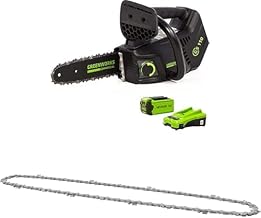


Greenworks cordless chainsaws are particularly worth considering when you want the convenience of battery power without the fuel, exhaust fumes, petrol storage and engine maintenance associated with a petrol chainsaw. For UK buyers, however, choosing the right model is about more than selecting the largest guide bar or the highest quoted voltage. Battery platform, cutting capacity, chain speed, motor technology, weight, ergonomics and the type of timber you expect to cut all influence whether a particular chainsaw is genuinely suitable.
The Greenworks range spans compact cordless saws intended for lighter garden work through to more substantial battery chainsaws designed for larger branches, firewood preparation and demanding domestic cutting. The best choice therefore depends on the workload rather than simply the specification that looks most impressive on a product page.
One of the most important purchasing decisions is the battery platform. Greenworks produces cordless outdoor power equipment around different battery systems, and batteries are not automatically interchangeable across every Greenworks product family.
Before buying a chainsaw, identify the exact battery platform and voltage family of the model. If you already own Greenworks equipment, choosing a compatible chainsaw can be particularly attractive because the same battery ecosystem may allow one battery and charger to serve several tools.
Lower-voltage Greenworks chainsaws are generally better suited to lighter cutting tasks. They can make sense for homeowners who primarily need to prune branches, deal with smaller fallen limbs or maintain a garden rather than process substantial quantities of firewood.
The principal advantage is usually a compact form factor. A lighter saw can be easier to control when working around a garden, although the precise weight and cutting capability depend on the individual model and whether the battery is included in the quoted weight.
Greenworks 40V cordless chainsaws occupy a useful middle ground for many domestic users. They can provide more cutting capability than compact garden saws while retaining the relatively simple operation associated with battery equipment.
A 40V model may be appropriate when your work includes regular branch cutting, garden maintenance, storm-damaged limbs and occasional firewood preparation. The correct choice still depends on guide-bar length, motor design, chain speed and the diameter and species of timber involved.
Higher-voltage Greenworks platforms are intended for users who require greater cutting performance and longer working capability. These models can be relevant when a compact domestic saw would be underpowered for the intended workload.
Higher voltage does not automatically mean that one chainsaw is better for every buyer. A larger battery and more powerful saw can also increase overall weight and cost. For pruning small branches, a lightweight saw may be substantially easier to use than a larger professional-oriented machine.
Guide-bar length is one of the easiest specifications to understand but one of the most frequently misunderstood. A longer bar increases the potential cutting capacity of a chainsaw, but it does not mean that the saw should routinely be used to cut timber equal to the full bar length.
For light garden work, a compact guide bar can provide better manoeuvrability and control. Medium-length bars can offer a more versatile compromise for general domestic cutting. Longer bars become more relevant when regularly dealing with larger timber, although the chainsaw must have sufficient motor and battery capability to use the bar effectively.
Do not select a Greenworks chainsaw solely because it has the longest guide bar available. Match the bar to the manufacturer's approved specification and your normal cutting requirements.
Chain speed is another important specification when comparing cordless chainsaws. It describes how quickly the chain travels around the guide bar and can provide useful information about the saw's intended character.
A higher quoted chain speed can contribute to faster cutting under suitable conditions, but real-world cutting performance also depends on motor output, chain design, chain sharpness, timber species, moisture content, diameter and how aggressively the saw is being used.
This is why specifications should be assessed as a group rather than in isolation. A chainsaw with an impressive chain-speed figure is not necessarily the best choice if its weight, battery capacity or ergonomics make it unsuitable for the work you actually perform.
Brushless motor technology is an important consideration when comparing modern cordless power tools. Greenworks offers brushless technology in parts of its cordless outdoor power-tool range, and a brushless chainsaw can be attractive for buyers who expect frequent use.
Brushless motors eliminate the conventional mechanical brushes used in brushed motors. This design can support efficient electronic motor control and avoids brush wear as a maintenance item. The actual performance, however, remains dependent on the complete chainsaw system rather than the motor label alone.
Brushless should therefore be treated as one useful buying criterion rather than proof that a particular model is automatically superior.
Battery capacity is normally expressed in ampere-hours, abbreviated as Ah. A higher Ah rating generally represents greater stored energy within the same battery platform, although actual runtime varies significantly according to the workload.
Chainsaw runtime can change depending on timber diameter, wood species, chain sharpness, cutting technique, ambient temperature, battery condition and how continuously the saw is operated. Consequently, advertised runtime figures should not be interpreted as a guaranteed number of minutes of cutting.
A smaller battery can be suitable for occasional pruning and short garden tasks. It may also reduce the overall weight of the chainsaw, which can make a noticeable difference during repeated cuts.
A higher-capacity battery is more attractive when you expect longer sessions or heavier cutting. The trade-off is additional battery weight and potentially higher purchase cost. If you already have compatible Greenworks batteries, the most economical solution may be to choose a chainsaw that works with the batteries already in your collection.
One of the most common cordless-tool buying mistakes is assuming that batteries from the same manufacturer are universally interchangeable. Greenworks has multiple voltage and product families, so buyers should confirm compatibility using the exact model information before purchasing a battery, charger or bare-tool chainsaw.
If a chainsaw is advertised as a bare tool, check carefully whether the battery and charger are excluded. A seemingly inexpensive chainsaw can require a substantially larger total investment if you also need a compatible battery and charger.
Proper chain lubrication is essential for a cordless chainsaw. Automatic oiling systems are designed to deliver chain oil while the saw operates, reducing the need for constant manual application.
Even with automatic lubrication, users should not assume that the oiling system eliminates maintenance. The oil reservoir needs to be filled with the appropriate chain oil, the oiling system should remain free of debris and the chain should be inspected regularly.
Always follow the specific Greenworks manual for the chainsaw you own because lubrication arrangements and maintenance procedures can vary between models.
Tool-free chain adjustment can make routine maintenance considerably more convenient. A suitable chain tensioning system allows the operator to compensate for normal chain movement without repeatedly reaching for a separate tool.
Correct chain tension is critical. A chain that is excessively loose can create safety and cutting problems, while excessive tension can increase friction and place unnecessary load on components.
Check the chain tension according to the manufacturer's instructions before using the saw. A new chain can require more frequent tension checks during its initial period of use because chain components can settle during operation.
Safety equipment should receive more attention than cosmetic features when comparing cordless chainsaws. A chain brake is a particularly important component because it is designed to stop chain movement rapidly when activated.
Depending on the Greenworks model, additional safety features may include a trigger interlock, hand guard, electronic controls and protective systems designed around the particular chainsaw architecture.
Do not assume that the presence of a safety feature makes unsafe cutting practices acceptable. A cordless chainsaw remains a serious cutting tool and should be operated only according to the manufacturer's instructions and appropriate safety practices.
Weight becomes increasingly important during pruning and overhead or awkward-position work. A chainsaw that feels manageable for a few cuts can become tiring during an extended session.
When comparing specifications, check whether the stated weight includes the battery. Cordless tools can have substantially different quoted weights depending on whether manufacturers measure the bare tool or the complete working configuration.
Balance matters as well. Two chainsaws with similar weights can feel different because the motor, battery and guide bar distribute mass differently. If possible, consider the physical layout of the tool rather than relying only on the number printed in the specification list.
Good chainsaw ergonomics are not simply about comfort. Handle position and grip design affect how easily the operator can maintain control while making different types of cuts.
Look for a configuration that allows both hands to remain securely positioned and provides clear access to the primary controls. A well-designed hand guard and comfortable grip can become increasingly important during repetitive garden maintenance.
If your primary objective is pruning branches, a compact cordless chainsaw can often be more appropriate than a large model. Pruning generally benefits from low weight, easy manoeuvrability and precise control.
There is little advantage in buying a heavy, high-capacity chainsaw if the majority of your work consists of smaller branches. A smaller Greenworks model may be easier to carry and quicker to deploy for short garden jobs.
Firewood preparation changes the purchasing equation. Repeatedly cutting logs places greater demands on the chain, motor and battery than occasional pruning.
For firewood, pay particular attention to guide-bar length, chain speed, battery capacity, motor technology and the availability of compatible spare batteries. If you regularly process substantial quantities of timber, a more capable Greenworks platform may make more sense than a compact garden saw.
Remember that a cordless chainsaw's suitability for firewood depends on the size and type of timber. A homeowner preparing a modest quantity of relatively small logs has very different requirements from someone processing large rounds throughout the winter.
Storm damage presents additional considerations. Fallen branches can be under tension, partially supported or positioned unpredictably. These conditions can create hazards that are not present during straightforward garden pruning.
A cordless chainsaw can be convenient for dealing with ordinary small branches after bad weather, but users should not attempt technically difficult or dangerous cuts simply because a chainsaw is powerful enough to make them.
Large fallen trees, heavily tensioned limbs, branches near buildings or power lines and unstable timber should be left to appropriately trained professionals.
Greenworks is not the only established manufacturer competing in the UK cordless outdoor power-tool market. Buyers may also encounter cordless chainsaws from brands such as EGO, Husqvarna, Makita, STIHL and Ryobi.
The right comparison is not simply brand versus brand. Battery ecosystem, dealer support, tool availability, compatible equipment, guide-bar options, replacement chains, battery cost and the intended workload can all influence the better long-term choice.
EGO is known for a broad cordless outdoor power-tool ecosystem. When comparing EGO and Greenworks chainsaws, look beyond headline voltage and examine the complete battery platform, tool weight, guide-bar specification, cutting performance and the other equipment you may eventually want to operate from the same battery family.
Husqvarna has extensive experience in chainsaws and professional forestry equipment. A comparison can therefore be particularly relevant for buyers whose needs are moving beyond ordinary garden maintenance. Greenworks may remain attractive where a homeowner prioritises a battery-powered garden-tool ecosystem, while Husqvarna can be worth investigating for buyers with more demanding chainsaw requirements.
Makita's cordless outdoor tools can be especially interesting for customers who already own compatible Makita batteries and power tools. Compare the complete ecosystem cost rather than comparing the chainsaw alone.
STIHL offers extensive chainsaw expertise across battery and petrol equipment. For a domestic buyer, the important question is whether the additional range of equipment and chainsaw configurations offered by STIHL is relevant to the intended workload or whether Greenworks provides the more suitable cordless ecosystem.
Ryobi's ONE+ ecosystem is a significant consideration for homeowners who already use compatible Ryobi equipment. Greenworks should similarly be evaluated as part of a broader battery ecosystem rather than as an isolated chainsaw purchase.
A bare-tool chainsaw can be an excellent option when you already own compatible Greenworks batteries and a suitable charger. It avoids purchasing duplicate battery equipment.
A complete kit can make more sense for a first-time Greenworks battery-tool buyer. When comparing kit prices, check exactly what is included, including battery capacity, charger type, guide bar, chain and any supplied accessories.
Higher voltage can indicate a more powerful battery platform, but the largest system is not necessarily the most suitable for pruning or light domestic work. Extra capability can mean additional weight and expense.
A longer bar is not automatically better. It can add weight and may be unnecessary for smaller branches. Select the guide-bar size appropriate to the manufacturer's specification and your normal timber diameter.
The chainsaw itself is only part of the cordless system. If the model is sold without a battery and charger, calculate the complete purchase requirement before comparing prices with a kit or another brand.
Ampere-hours alone do not provide a complete picture of stored battery energy. Battery voltage and ampere-hours should be considered together when comparing different battery platforms.
A dull chain can make even a capable cordless chainsaw appear weak. It increases cutting effort and can make the tool behave poorly. Regular inspection and correct chain sharpening are fundamental parts of chainsaw ownership.
Before buying, investigate the availability and specification of replacement chains, guide bars and batteries. A chainsaw is a long-term tool, so consumables and replacement components matter almost as much as the initial specification.
The chain is the component that directly performs the cutting, making its condition central to performance. Keep the chain correctly tensioned and sharp according to the manufacturer's instructions.
Inspect the chain for damage before use. A damaged or excessively worn chain should not simply be forced through timber. Use the correct replacement chain specified for the particular chainsaw and guide-bar configuration.
Signs of a chain that needs attention can include noticeably slower cutting, increased pressure required to make a cut, unusual vibration and a change in the character of the material leaving the cut. A properly maintained chain should cut efficiently without requiring excessive downward force.
Chain sharpening requires the correct file size, filing angle and depth-gauge treatment for the specific chain. Buyers who are unfamiliar with chainsaw maintenance should consult the Greenworks manual or use an appropriately qualified service professional.
After use, remove accumulated sawdust and debris from accessible areas according to the manufacturer's cleaning instructions. Particular attention should be paid to areas around the guide bar, chain, sprocket and ventilation openings.
Battery-powered does not mean maintenance-free. Keeping the tool clean can make it easier to identify damage, oiling problems, excessive wear and chain issues before the next cutting session.
Lithium-ion batteries should be stored and handled according to the manufacturer's instructions. Avoid exposing batteries to unsuitable temperatures, moisture or physical damage.
Do not use a battery that is visibly damaged, swollen or otherwise compromised. Use the charger intended for the relevant Greenworks battery platform and follow the manufacturer's charging and storage guidance.
British weather can influence when and how a cordless chainsaw is used. Cold temperatures can affect battery performance, while wet conditions can make timber, ground surfaces and handling more hazardous.
Wet wood can also behave differently during cutting, and poor weather can make visibility and footing worse. A chainsaw should not be selected solely on the assumption that battery power makes it suitable for every outdoor condition.
When reviewing several highly rated Greenworks models, use a consistent checklist rather than relying on star ratings alone. Customer ratings can provide useful insight into ownership experiences, but the relevance of those experiences depends on whether reviewers used the chainsaw for similar tasks.
Customer feedback can be useful for identifying recurring ownership themes, such as battery convenience, ease of chain adjustment, perceived weight and suitability for particular garden tasks. It should not, however, replace technical specifications or manufacturer instructions.
When reading reviews, look for detailed comments that explain what the reviewer actually cut, how frequently the tool was used and which battery configuration was fitted. A review describing excellent performance on small branches does not necessarily establish that the same chainsaw is suitable for heavy firewood processing.
Specification sheets can appear complicated because different models emphasise different measurements. The most useful approach is to identify the specifications that directly correspond with your workload.
Prioritise low weight, compact dimensions, easy chain adjustment, manageable battery size and sufficient cutting capacity. Buying significantly more power than necessary can make a pruning saw unnecessarily cumbersome.
Look for a balanced combination of guide-bar length, motor performance, battery capacity, ergonomics and maintenance convenience. This is where a mid-range Greenworks cordless chainsaw can make sense for many homeowners.
Give greater weight to motor capability, chain speed, battery capacity, replacement battery availability and overall durability considerations. The ability to keep several charged batteries available can be as important as the nominal cutting specification.
A chainsaw should be treated as a high-risk cutting tool regardless of whether it uses a petrol engine or battery motor. Appropriate protective equipment is an important part of responsible use.
Follow the manufacturer's safety instructions and use protective equipment appropriate to the cutting conditions. Protective equipment should complement, not replace, safe operating technique.
Cordless technology is highly convenient, but it is not ideal for every situation. A homeowner who needs only occasional pruning may find a compact battery saw more appropriate than a larger chainsaw. Conversely, someone regularly processing large volumes of substantial timber may need equipment designed specifically for heavier professional workloads.
If the job involves trees close to structures, power lines, public areas or complicated tensioned branches, the deciding factor should not be which chainsaw has the highest specification. Professional tree work can require specialist training, equipment and risk assessment.
Choose a compact Greenworks cordless chainsaw with a manageable guide bar and low overall weight. Battery capacity does not need to be excessive if the saw will only be used for short sessions.
A mid-range model with a useful guide-bar length, good ergonomics, automatic chain lubrication and a compatible battery platform can offer a strong balance for typical garden maintenance.
Prioritise motor performance, battery capacity, chain speed and the availability of additional batteries. A more substantial Greenworks platform may be preferable when cutting sessions are longer and timber is larger.
The strongest option may simply be the chainsaw compatible with the Greenworks batteries and charger already in your tool collection, provided that its cutting capability matches the intended workload.
A cordless chainsaw can become more economical to own when its battery platform is shared with other outdoor power tools. Depending on the compatible Greenworks system, one battery family may be used across several categories of equipment.
This can reduce the need to purchase separate batteries for every tool. However, buyers should check exact compatibility rather than assuming that every Greenworks battery fits every Greenworks product.
The initial purchase price is only one part of the cost of cordless chainsaw ownership. Consider the expected cost and availability of batteries, chargers, chains, guide bars and other consumables over the life of the tool.
Battery longevity is also relevant. Rechargeable batteries are consumable components, and their usable capacity can change over time and with usage conditions. Buyers planning to keep a cordless chainsaw for many years should therefore consider the wider battery ecosystem and the availability of compatible replacement batteries.
They can be a practical option for many UK garden-maintenance tasks, particularly where users value low routine maintenance, convenient starting and the absence of petrol-engine exhaust. The appropriate model depends on branch size, frequency of use and the battery platform.
There is no single best model for every buyer. A compact saw can be preferable for pruning, while a larger battery chainsaw may be more appropriate for heavier cutting and firewood preparation. Compare the guide bar, battery system, motor, weight and intended workload before choosing.
Compatibility depends on the specific Greenworks battery platform and tool family. Do not assume that a battery will fit simply because both products carry the Greenworks name. Always verify compatibility for the exact model numbers.
Yes. Chainsaw chains require appropriate lubrication, and models equipped with automatic oiling systems still require the oil reservoir to be maintained. Follow the individual product manual for the correct lubrication procedure.
There is no universal interval because sharpening frequency depends on the amount and type of cutting. Inspect the chain regularly and sharpen it when cutting performance deteriorates or other signs indicate that the chain is becoming dull.
Some Greenworks chainsaws can be suitable for domestic firewood cutting when the timber size is within the manufacturer's stated capability. Larger or frequent firewood workloads may justify a more powerful model and additional batteries.
They generally eliminate petrol-engine tasks such as fuel mixing, spark-plug maintenance and carburettor-related servicing. They still require chain sharpening, chain tension checks, lubrication, cleaning, battery care and inspection of wear components.
Not necessarily. A longer guide bar can increase cutting capacity, but it can also increase weight and reduce manoeuvrability. Select the bar length according to the timber you expect to cut and the manufacturer's approved configuration.
A higher-capacity battery primarily provides more stored energy within the relevant platform. It should not be treated as a simple replacement for the chainsaw's motor or voltage specification. Actual cutting performance depends on the complete tool and battery system.
If you already have a compatible Greenworks battery and charger, a bare tool may avoid unnecessary duplication. If you are entering the battery platform for the first time, a complete kit can be more convenient. Compare the total cost of the required equipment rather than the chainsaw price alone.
Look for detailed feedback concerning actual cutting tasks, battery usage, chain adjustment, weight, ergonomics and long-term ownership. Give more weight to reviews describing conditions similar to your own rather than relying exclusively on an overall star rating.
Outdoor conditions require careful consideration. Follow the manufacturer's instructions regarding weather and moisture exposure, and never compromise footing, visibility or safe handling simply because the tool is battery powered.
The best top-rated Greenworks cordless chainsaw is ultimately the one whose battery platform, guide bar, motor capability, weight and ergonomics match the work you actually need to perform. For occasional pruning, prioritise compact size and control. For general garden maintenance, look for a balanced combination of cutting capacity and usability. For regular firewood preparation, pay greater attention to motor performance, battery capacity and the ability to keep spare batteries available.
Before making a purchase in the UK, compare the exact model specifications rather than relying on the Greenworks brand name or a headline voltage figure. Check whether the product is sold as a bare tool or kit, verify battery compatibility, examine the guide-bar and chain specification, consider replacement consumables and read current customer feedback in the context of your intended workload.
Brands such as Greenworks, EGO, Husqvarna, Makita, STIHL and Ryobi all offer different approaches to cordless outdoor power equipment. The strongest choice is therefore not necessarily the most powerful or most expensive chainsaw. It is the model that provides sufficient cutting capability without adding unnecessary weight, cost or complexity for the jobs you expect to do.