

♥ Wishlist
Compare 48 verified Festool Cordless Screwdrivers products in United Kingdom. Reviews, ratings, pros, cons and buying advice updated for October 2026.


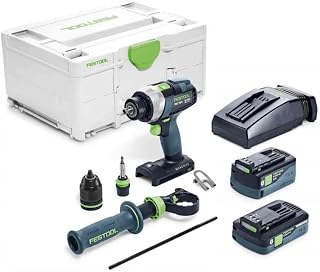


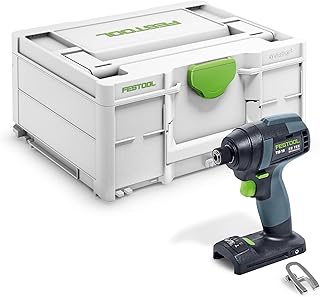


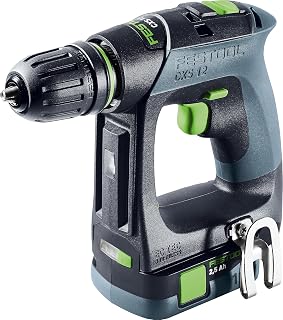


Choosing a Festool cordless screwdriver is less about finding the most powerful specification and more about matching the tool's design, torque range, battery platform, chuck system and accessories to the work you actually do. Festool's current cordless drill and screwdriver range includes compact 18 V models such as the CXS 18 and TXS 18, larger drill drivers such as the C 18 and T 18+3, high-torque QUADRIVE models such as the TDC 18/4, and the impact screwdriver TID 18. These tools overlap in some applications, but they are not interchangeable in how they deliver power.
For UK tradespeople, furniture installers, kitchen fitters, joiners, cabinet makers, electricians, maintenance professionals and serious DIY users, the most useful comparison is therefore application-led. A compact screwdriver may be preferable for repeated cabinet installation, while a four-speed QUADRIVE can make more sense for large timber drilling and structural screwdriving. An impact screwdriver can be the better choice when driving larger screws efficiently without the characteristic twisting reaction of a conventional drill driver.
The CXS 18 and TXS 18 deserve particular attention if compact size is more important than maximum drilling capacity. Both are 18 V compact drill drivers with two-speed operation, brushless EC-TEC motors, FastFix compatibility and a 10 mm keyless chuck option. Festool specifies up to 35 mm drilling in wood with Forstner bits and screwdriving in softwood with screws up to 6 x 240 mm for these compact models.
The major distinction is the shape rather than the basic operating concept. The CXS 18 uses Festool's characteristic C-shaped configuration, positioning the handle along the drilling and screwdriving axis. This can provide a very direct feel when applying controlled pressure. The TXS 18 uses the classic T-shaped configuration, which many users may find more familiar when moving between conventional drill drivers.
Both models are specified at 18 V, with two gears and no-load speeds of 0–470 rpm and 0–1,600 rpm. Their stated maximum torque is 22 Nm in wood and 40 Nm in steel, with a 1–10 mm chuck range. The tool-only weight is listed at 0.70 kg, making these particularly relevant when repetitive overhead or confined-space work is part of the job.
The C 18 and T 18+3 sit above the compact CXS/TXS 18 concept and are worth considering when drilling capacity and broader general-purpose performance are more important than minimum size. The C 18 uses the C-shaped design, while the T 18+3 uses the traditional T-shaped arrangement.
The C 18 specification includes two gears with no-load speeds of 0–450 rpm and 0–1,500 rpm. Festool lists drilling diameters of up to 40 mm in wood and 13 mm in steel, a 1.5–13 mm chuck range, torque adjustment from 0.8–8 Nm in first gear and 0.5–6 Nm in second gear, and maximum torque of 27 Nm in wood and 45 Nm in steel.
This illustrates an important buying point: a larger chuck and greater drilling capacity can be more valuable than simply choosing the newest or most compact model. If you routinely use larger conventional drill bits, the C 18/T 18+3 class deserves consideration over a compact screwdriver.
The TDC 18/4 is designed for users who need a wider operating range from a single cordless drill driver. Its four-speed gearbox provides considerably more flexibility than a typical two-speed compact screwdriver. Festool specifies four gears with no-load speeds ranging from 0–500 rpm and 0–800 rpm in the first two gears to 0–2,350 rpm and 0–3,600 rpm in the third and fourth gears.
The stated maximum torque is 50 Nm in wood and 75 Nm in steel, while drilling capacity is listed at up to 70 mm in wood and 13 mm in steel. The chuck range is 1.5–13 mm. Festool also specifies applications including screws up to 10 x 300 mm in wood and Forstner drilling up to 70 mm.
For a professional who moves between large screwdriving, high-speed drilling and larger timber holes, the four-speed design can be more useful than simply buying a compact screwdriver with a larger battery. The important distinction is that gear selection changes the tool's operating characteristics; battery capacity alone does not turn a compact drill driver into a high-capacity QUADRIVE.
The TID 18 should not be treated simply as another version of a Festool cordless drill. It uses an impact mechanism and a 1/4-inch tool holder, making it particularly suited to screwdriving rather than general-purpose drilling with conventional round-shank drill bits.
Festool specifies three speed settings plus T-mode, a maximum torque of 180 Nm and a maximum speed of 3,200 rpm. The impact mechanism can deliver up to 4,500 impacts per minute. The tool is specified for screws up to 8 x 220 mm in softwood.
A key distinction is the tangential hammer mechanism. Instead of applying the same type of rotational reaction associated with a conventional drill driver when high resistance is encountered, the impact mechanism delivers its action tangentially. This can make demanding screwdriving more comfortable, particularly where long or large fasteners are involved.
The TID 18 also has a 1/4-inch holder, integrated bit storage, LED work lighting and a belt clip that can be positioned on either side. It is compatible with Festool's relevant 18 V battery system, allowing users already invested in compatible batteries to build a more unified cordless setup.
The choice between a conventional Festool cordless drill driver and the TID 18 should begin with the workpiece and fastener rather than the headline torque number.
Comparing cordless screwdrivers solely by voltage or maximum torque can produce the wrong result. The following specifications are more useful when comparing Festool models for professional work.
Festool's current cordless screwdriver range includes both 12 V and 18 V categories, while the models commonly considered for demanding professional work include 18 V machines. An 18 V platform offers a broader range of tool sizes and applications, but a higher voltage does not automatically make one model better for every task.
Battery capacity is normally expressed in ampere-hours (Ah). A higher Ah rating can provide greater energy storage, but it can also add weight and alter the balance of the tool. For overhead installation, cabinetry and repetitive fastening, a smaller battery may produce a more comfortable overall combination. For demanding drilling and long work periods away from a charger, greater capacity can be more attractive.
Festool's current compact CXS 18 and TXS 18 systems are compatible with the current Festool 18 V battery range apart from the Ergo battery pack. The exact battery supplied depends on the selected product set, so the contents of a listing should always be checked before purchasing.
Maximum torque is useful for understanding the potential of a machine, but it should not be interpreted as the ideal torque for every screw. Controlled torque adjustment is particularly important for furniture, cabinetry, hinges, fittings and other applications where excessive force can damage the fastener or workpiece.
No-load speed indicates how quickly the spindle can rotate without load. Lower speeds generally suit controlled screwdriving and larger drilling operations, while higher speeds can be useful with appropriate smaller drill bits. The correct speed also depends on the material, bit type and diameter.
A 10 mm chuck is sufficient for many compact drilling and fastening applications. A 13 mm chuck can provide greater flexibility for larger conventional drill bits. The chuck should therefore be assessed against the sizes and shank types of the accessories you actually use.
The TID 18's 1/4-inch tool holder is fundamentally different from a conventional drill chuck. It is optimised for compatible screwdriver bits and quick bit changes rather than accepting the same broad range of cylindrical drill-bit shanks as a conventional chuck.
One of the strongest reasons to consider Festool as a system rather than as an isolated cordless screwdriver is the attachment ecosystem. FastFix allows compatible attachments to be changed without conventional tool-based chuck operations, while CENTROTEC combines drill and bit-holder functionality in a compact quick-change concept.
Depending on the compatible model and selected accessories, the system can extend a drill driver into applications involving angled drilling, angled screwdriving, eccentric screwdriving and depth-controlled fastening. This matters when working close to cabinet edges, inside awkward corners or around fittings where a standard drill-driver configuration is difficult to position.
Before paying extra for a particular kit, check exactly which attachments are included. A bare tool can look attractive in a comparison table but may become considerably less economical if the accessories you require have to be purchased separately.
Festool products are commonly offered in different configurations. A Basic version may be aimed at users who already own compatible batteries and chargers, while a more comprehensive set can include batteries, charger, attachments, bits and a Systainer³ storage case.
There is no universally best package. An existing Festool 18 V user may find a bare or Basic tool more sensible because compatible batteries and chargers are already available. Someone entering the battery platform for the first time may prefer a set containing the battery and charging equipment.
For mobile tradespeople, storage and transport can be almost as important as the screwdriver itself. Many Festool cordless products are supplied in or designed around the Systainer system, which provides a structured way to transport the tool, batteries and accessories.
This can be particularly useful for kitchen fitting, joinery, shopfitting and installation work where the same tool moves repeatedly between a workshop, van and jobsite. However, buyers should compare the exact package rather than assuming every version of a model contains the same storage system.
A cordless screwdriver can be technically capable yet poorly suited to a job if its size, weight or balance creates unnecessary fatigue. This is particularly relevant when installing cabinets, fittings, doors, wall-mounted components or other items that require repeated overhead work.
Consider how the tool sits in your hand, how close the grip is to the working axis, whether the battery obstructs access and whether you can comfortably reach the forward/reverse selector and speed trigger while wearing normal work gloves.
The CXS 18 and TXS 18 are particularly relevant to this consideration because their compact designs are intended to make drilling and fastening easier in restricted areas. The larger C 18, T 18+3 and TDC 18/4 models provide greater capability but should be evaluated with their additional size and weight in mind.
A huge torque figure is not automatically beneficial for cabinet assembly, furniture fitting or precision fastening. Controlled torque settings and predictable trigger response can be more important than maximum output.
If you drill regularly, check the chuck range and compatibility with your existing drill bits. An impact screwdriver with a 1/4-inch holder is not a substitute for a conventional drill chuck.
A larger package is not necessarily better value. If you already own compatible batteries, a charger and the required attachments, paying for duplicates may make little sense.
A larger battery can increase runtime, but it can also increase the overall weight of a compact tool. Match battery size to the duration and intensity of the work rather than assuming the largest available pack is always preferable.
These tools perform overlapping fastening tasks but have different operating characteristics. If drilling is important, a conventional drill driver is usually the more versatile choice.
The total cost of ownership includes batteries, charger, chucks, specialist attachments, bits and storage if these are not already owned. Compare complete configurations rather than comparing tool-only prices in isolation.
Battery compatibility depends on the specific tool and battery family. Check the manufacturer's compatibility information and the exact product specification before purchasing additional batteries.
For furniture, cabinetry and kitchen assembly, compactness and control are normally more important than maximum drilling capacity. The CXS 18 and TXS 18 are particularly well matched to this type of work because of their compact 18 V design, torque adjustment, quick-change attachment system and suitability for confined areas.
The decision between the two largely comes down to handling preference: the CXS 18 uses the C configuration, whereas the TXS 18 uses the T configuration. If you regularly work around cabinet interiors, corners and fittings, the ability to add compatible angle or eccentric attachments can also be valuable.
For joinery involving larger timber holes and long structural screws, the TDC 18/4 is a more appropriate comparison point than the compact CXS 18 or TXS 18. Its four-speed gearbox, higher torque capability and larger drilling capacity are designed for substantially more demanding applications.
The appropriate tool still depends on the material, fastener, drill diameter and frequency of use. A larger machine can be unnecessary for predominantly light joinery, while a compact model can become frustrating when repeatedly asked to perform large-hole drilling.
When the main job is driving screws rather than drilling, the TID 18 deserves consideration. Its impact mechanism, 180 Nm maximum torque, three speed settings, T-mode and 1/4-inch holder make it a specialist fastening tool rather than simply a smaller drill driver.
It can be particularly relevant to timber construction, fencing, pergolas, canopies, substructures, door and window installation, and other applications involving substantial screwdriving. The correct bit and fastener combination remains essential, and the manufacturer's stated application limits should be observed.
When comparing two models, use the same criteria rather than allowing one impressive specification to dominate the decision.
Professional cordless tools generally require less routine maintenance than brushed machines, but good care remains important. Keep ventilation openings clear, remove dust and debris after use, inspect the chuck or tool holder regularly and check bits for wear before demanding applications.
Use the appropriate Festool charger and follow the manufacturer's instructions for the particular battery. Avoid using visibly damaged battery packs. Store batteries in suitable conditions and inspect the contacts and casing periodically.
Keep the chuck, CENTROTEC interface and FastFix connection areas clean. Do not force an attachment that does not seat correctly. A quick inspection before use can prevent poor engagement and unnecessary wear.
A high-quality cordless screwdriver cannot compensate for a worn or unsuitable bit. A poor-fitting bit can slip, damage the screw head and make the user apply unnecessary pressure. Match the bit type and size to the fastener and replace worn bits rather than continuing to use them.
Torque adjustment is particularly useful for repeatable fastening. Start with a conservative setting and increase it only when the fastener does not reach the required seating depth. The correct setting varies with screw diameter, thread design, material density, pilot-hole size, surface finish and the required clamping force.
For cabinetry and furniture, excessive torque can strip the screw, damage a board or pull a fitting out of alignment. For structural or heavy-duty applications, the manufacturer's application limits and the fastener manufacturer's requirements should take precedence over simply selecting the highest available torque.
“Top rated” should not be interpreted as a single universal technical ranking. Customer ratings can provide useful information about ownership satisfaction, but ratings alone do not establish that one cordless screwdriver is objectively better for every trade or application.
A more useful buying decision combines customer feedback with verified specifications, intended use, ergonomics, accessory compatibility, battery requirements and total package contents. Buyers should also check recent retailer information because product configurations, included accessories and availability can change.
There is no single best model for every user. The CXS 18 and TXS 18 are strong candidates for compact general-purpose drilling and screwdriving, while the C 18 and T 18+3 offer greater full-size versatility. The TDC 18/4 is more appropriate for demanding drilling and large screwdriving.
They are closely related compact 18 V models. The main ergonomic difference is the body configuration: the CXS 18 uses Festool's C shape and the TXS 18 uses the T shape. Choose according to which grip and working position suits your applications.
The TID 18 is an impact screwdriver rather than a conventional drill driver. It uses a 1/4-inch tool holder and is designed primarily for screwdriving. If you need regular drilling with conventional drill bits, a Festool cordless drill driver is generally the more versatile option.
For many professional drilling and screwdriving applications, Festool's 18 V platform provides substantial capability. The appropriate model still depends on the job: compact installation work, general drilling, large timber drilling and impact screwdriving place different demands on a machine.
No. A higher-capacity battery can provide greater energy storage but may increase weight. For lightweight installation work, a smaller battery may provide a better balance, whereas demanding applications may justify additional capacity.
Festool states that current 18 V screwdriver attachments are compatible with the CXS 18 and TXS 18. Always verify compatibility for the exact attachment and tool configuration before purchasing.
CENTROTEC is Festool's quick-change system for compatible drilling and fastening accessories. It is intended to make accessory changes fast while keeping the setup compact.
FastFix is a tool-free interface used on compatible Festool cordless screwdrivers to change attachments. Depending on the tool and attachment, it can support configurations for standard drilling, angled drilling, angled screwdriving, eccentric screwdriving and depth-controlled applications.
Yes, they can be, particularly for users who value professional ergonomics, system compatibility and long-term tool investment. However, the higher specification of professional equipment can be unnecessary for occasional light DIY jobs, so the cost should be assessed against actual usage.
There is no universal replacement interval. Replace bits when the tip becomes visibly worn, no longer seats securely in the fastener or begins slipping during normal use. Heavy professional use can wear bits considerably faster than occasional household use.
Choose a bare or Basic version if you already own compatible batteries and charging equipment. A complete set can make more sense when you are entering the Festool battery system and need batteries, charger, attachments and storage.
Before choosing among the top-rated Festool cordless screwdrivers available to UK buyers, use this checklist:
An independent buying guide should distinguish between measurable specifications and subjective claims. For this reason, comparisons should focus on the manufacturer's stated technical data, intended applications, tool configuration, battery requirements, ergonomics, accessory ecosystem and practical differences between models. Customer feedback can then be used as an additional ownership signal rather than treated as a substitute for technical specifications.
Product specifications and package contents can change, so UK buyers should verify the exact model, article number, included accessories, battery configuration, current retailer price and availability before placing an order. This is particularly important when comparing Basic, Set and Plus versions of the same Festool cordless screwdriver.