

♥ Wishlist


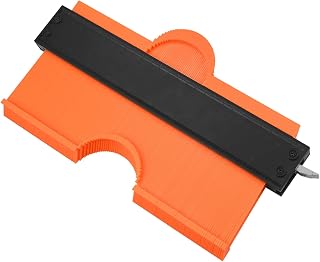


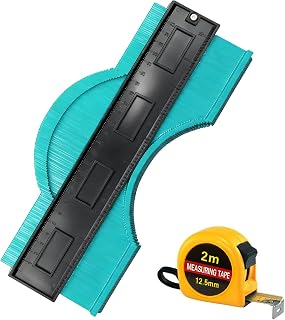

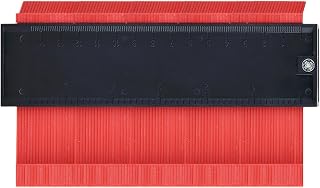


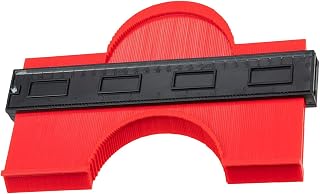


A contour gauge is a useful measuring and marking tool designed to reproduce the shape of irregular objects and surfaces. Instead of relying on repeated measurements or trying to draw a complicated curve by eye, you can press the gauge against the profile you need to copy. The individual pins or blades conform to the shape, creating a template that can then be transferred to another material.
For UK tradespeople, installers, woodworkers and DIY users, a contour gauge can make awkward fitting tasks considerably easier. It is particularly helpful when a straight ruler or conventional tape measure cannot accurately describe a curved edge, uneven wall, decorative moulding or irregular pipe profile.
A contour gauge consists of a row of movable pins enclosed within a frame. When the gauge is pressed against an object, the pins move to follow its outline. You can then lock or hold the captured profile and use it as a guide for marking your chosen material.
This simple design makes contour gauges useful for transferring shapes without creating a full cardboard template first. Depending on the job, they can help reproduce the outline of pipes, door frames, skirting boards, tiles, flooring edges, timber profiles and other difficult shapes.
Contour gauges are suitable for many workshop, building and home improvement applications. Flooring installers can use them to trace around door frames, corners and irregular walls before cutting boards or other floor coverings. Tilers can use a captured profile when tiles need to fit around pipes, fixtures or unusual edges.
Woodworkers and joiners can also use profile gauges when working around mouldings, furniture components and curved surfaces. DIY users may find them valuable for projects where accurate shape transfer is more important than taking a series of individual measurements.
Consider the depth of the contour you need to capture. A gauge with suitable pin coverage can reproduce deeper or more pronounced profiles without leaving part of the shape unrecorded.
The width determines how much of a profile can be captured in one pass. A wider gauge can be useful for larger objects, while a compact model may be easier to handle in confined areas.
For detailed profiles, the pins should respond smoothly to changes in shape. Fine movement can help when copying relatively intricate outlines, while robust pins can be beneficial for demanding workshop use.
Some contour gauges include a locking feature that helps hold the captured profile in place. This can make transferring the shape easier because the pins are less likely to move while you mark your material.
If the gauge will be used regularly, look for a durable frame and pins that can withstand repeated adjustments. A well-made profile gauge should remain practical for workshop, installation and DIY applications.
Start by placing the contour gauge against the edge or surface you want to copy. Press it gently and evenly until the pins follow the complete profile. Avoid excessive pressure, particularly when working with delicate surfaces.
Once the profile has been captured, check that the pins represent the complete outline. If the gauge has a locking mechanism, secure the profile before moving it. Place the gauge against your workpiece and mark along the captured edge. You can then cut, trim or shape the material according to the transferred outline.
One of the biggest advantages of a contour gauge is its ability to simplify jobs involving irregular edges. Flooring and tiling projects often require accurate cuts around obstacles that are difficult to measure conventionally. Capturing the profile first can reduce guesswork and help create a cleaner fit.
In woodworking, a contour gauge can help reproduce existing shapes when making replacement pieces, fitting panels or working around architectural features. For general DIY, it can be a convenient alternative to making several trial cuts before achieving the desired shape.
When choosing a contour gauge, consider the material you will work with, the size of the profiles you need to copy and how frequently you expect to use the tool. A compact gauge may suit occasional household repairs and small projects, while a wider and more robust model may be preferable for regular trade or workshop applications.
It is also worth considering how easily the captured profile can be transferred. A clear profile, smooth-moving pins and a reliable locking arrangement can make the measuring process more convenient. Choose a design that matches the scale and accuracy requirements of your typical projects.
Manual measurements work well for straight lines and simple dimensions, but irregular profiles can require several measurements and calculations. A contour gauge captures the shape directly, helping you transfer a complex outline with fewer steps.
It is not a replacement for every measuring tool. A tape measure, ruler, square or other precision instrument may still be required for dimensions and positioning. However, a contour gauge can complement these tools when the main challenge is reproducing an unusual shape.
Explore contour gauge options for DIY, woodworking, flooring, tiling, joinery and general maintenance work. Choose a suitable size and design based on the profiles you need to copy and the type of projects you undertake. With the right contour gauge, awkward curves and irregular edges can become easier to trace, mark and reproduce accurately.
Find a practical contour gauge for copying awkward shapes, curves and profiles with greater accuracy. A contour gauge captures the shape of an object and transfers its outline to your workpiece, making it useful for flooring, tiling, woodworking, joinery, pipe fitting and general DIY projects across the UK.