

♥ Wishlist
Compare 54 verified Clamps Hand Tool products in United Kingdom. Reviews, ratings, pros, cons and buying advice updated for October 2026.










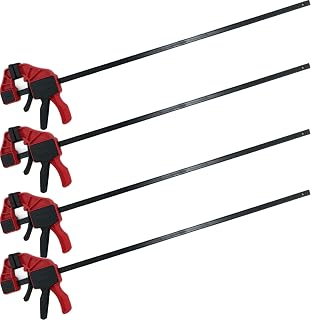


Choosing the right clamp is about much more than selecting the strongest-looking option. The best clamp depends on the material being held, the amount of pressure required, the available working space, the size of the workpiece and how frequently the tool will be repositioned. A clamp that is excellent for woodworking may be inconvenient for delicate assembly, while a compact quick-release model may be ideal for light-duty work but unsuitable when sustained high pressure is required.
For UK workshops, garages, home improvement projects and general DIY, it is useful to compare clamp type, throat depth, jaw capacity, clamping force, jaw protection, adjustment mechanism, construction materials and ease of operation before buying. Established tool brands such as Bessey, Irwin, Stanley, Bahco, Draper, Silverline, Faithfull and Wolfcraft offer different approaches to these requirements, so brand recognition alone should not determine the choice.
A clamp is a hand-operated tool designed to hold one or more objects securely in a fixed position. Clamps are commonly used while cutting, drilling, routing, gluing, sanding, assembling, repairing or positioning components. By preventing movement, a suitable clamp can improve accuracy and make many tasks safer and easier to control.
Clamps are particularly useful when adhesive needs time to cure. In woodworking, for example, a clamp can keep boards aligned while glue sets. During drilling or cutting, clamping can help prevent a workpiece from shifting unexpectedly. In metalworking and fabrication, heavier-duty clamps can provide considerably greater holding pressure than lightweight DIY models.
No single clamp is ideal for every task. The most useful approach is to match the clamp's design and capacity with the job rather than choosing purely on maximum advertised force or overall size.
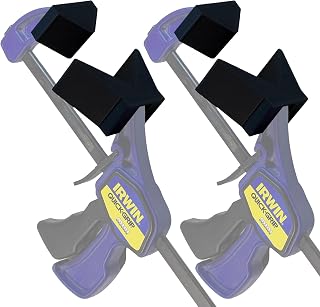
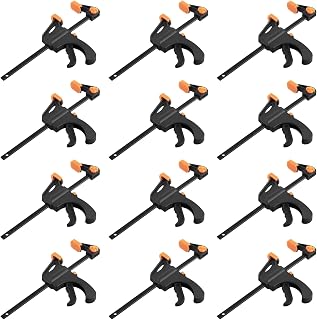
Quick-grip clamps are popular for DIY and general workshop use because they can usually be positioned and adjusted with one hand. A trigger mechanism allows the movable jaw to be advanced progressively, while a release mechanism permits the clamp to be repositioned quickly.
They are particularly convenient for temporary positioning, holding trim, securing smaller workpieces and supporting glue-up operations. Their main advantage is speed. Their limitation is that lightweight versions may not deliver the same sustained pressure or rigidity as a robust screw clamp.
F-clamps use a long bar with a fixed head and a sliding jaw. A screw mechanism provides the final clamping pressure. They are versatile workshop tools because their bar length can provide substantial capacity without requiring an excessively large body.
When comparing F-clamps, look beyond the stated maximum opening. Check the throat depth, bar construction, jaw shape and quality of the screw mechanism. A longer clamp is not automatically better if it flexes significantly under pressure.
G-clamps and C-clamps use a threaded screw to apply pressure directly between two jaws. They are simple, durable and well suited to applications where controlled pressure is more important than rapid adjustment.
These clamps can be useful for metalworking, woodworking, fabrication and repair work. Their relatively compact design makes them practical where there is limited space around the workpiece. However, they generally take longer to reposition than trigger-operated alternatives.
Bar clamps are designed for larger workpieces and longer spans. They are especially useful when assembling furniture, joining boards or holding broad components during adhesive work.
A long bar provides greater reach, but it also makes rigidity increasingly important. When evaluating a large bar clamp, consider whether the bar remains sufficiently stable under pressure and whether the jaws remain aligned throughout the adjustment range.
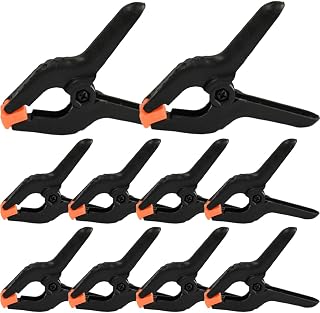
Spring clamps are compact and fast to use. Their spring-loaded jaws can be operated quickly and are suitable for light-duty positioning, craft work, temporary holding and some woodworking applications.
They are not normally the first choice when substantial sustained pressure is required. Their value lies in speed, convenience and portability.
Parallel clamps are designed so that the jaws remain parallel as they close. This can be particularly useful during cabinetmaking, furniture construction and accurate panel glue-ups where maintaining alignment is important.
They can be larger and heavier than general-purpose clamps, but the additional stability can be worthwhile for demanding woodworking projects.
Corner clamps are designed to hold components at a specific angle, often during frame, cabinet or box assembly. They can simplify positioning when two pieces need to meet accurately at a corner.
For occasional DIY use, a general-purpose clamp may be sufficient, but dedicated corner clamps become more useful when repetitive frame or cabinet construction is involved.
Pipe clamps use a separate length of pipe as the supporting bar. This design can provide substantial capacity and flexibility for large woodworking assemblies.
The advantage is scalability, but the system requires compatible components and an appropriate pipe. They are generally more attractive to serious woodworking users than someone who needs a small selection of everyday hand tools.
Jaw opening determines how wide an object the clamp can accommodate. Always consider the maximum opening in relation to the material you regularly work with rather than choosing the largest specification available.
It can be useful to own several clamps with different capacities rather than relying on one oversized model. A smaller clamp may be faster and easier to position for everyday jobs.
Throat depth is the distance from the bar or frame to the jaw area that contacts the workpiece. It determines how far the clamp can reach into the material.
This specification is easy to overlook. Two clamps can have similar maximum openings but very different practical reach. If you frequently work on wide boards or need to apply pressure away from an edge, throat depth deserves careful attention.
Clamping force indicates how much pressure the mechanism can apply. More force is not automatically better. Excessive pressure can mark timber, deform softer materials or squeeze too much adhesive from a joint.
The appropriate amount of force depends on the application. Delicate assembly may benefit from controlled, moderate pressure, while heavy fabrication can require a considerably stronger mechanism.
On F-clamps and bar clamps, the bar is a major structural component. A bar that bends significantly can reduce the effectiveness of the clamp and make it harder to maintain even pressure.
For larger clamps, inspect the shape and thickness of the bar and consider how the design distributes load. A well-designed rigid bar can be more valuable in practice than an impressive maximum opening figure.
Protective jaw pads can help reduce marks on timber, painted surfaces, laminates and other finished materials. Some clamps use removable pads, while others have integrated protective surfaces.
If the clamp will be used on visible or finished work, jaw protection should be treated as a significant buying consideration rather than a minor convenience.
The handle affects how easily pressure can be applied and how comfortable the clamp is during repeated use. A poorly shaped handle can become uncomfortable when several clamps need to be tightened during a large assembly.
Look for a handle that provides adequate grip without requiring awkward wrist positioning. For frequent workshop use, ergonomics can matter just as much as raw clamping capacity.
A smooth adjustment mechanism makes a clamp faster and more predictable to use. Trigger clamps prioritise speed, while screw-operated clamps typically provide finer control.
When comparing models, consider whether the movable jaw slides smoothly, whether the locking mechanism engages consistently and whether the screw remains easy to operate under load.
Steel is widely used for clamp bars, frames, screws and other load-bearing components because it provides strength and rigidity. Heavier steel construction can be beneficial for demanding applications, although it can also increase the overall weight.
For a home workshop, the best balance may be a clamp that is sufficiently rigid for the intended work without becoming unnecessarily heavy.
Cast metal bodies are common on traditional G-clamps and C-clamps. A substantial cast frame can provide a rigid structure for applying screw pressure.
Users should still consider the overall design, including the quality of the threaded screw and contact surfaces. A heavy body alone does not guarantee good performance.
Modern trigger clamps often combine metal components with reinforced plastic parts. This can reduce weight and make one-handed operation more convenient.
For general DIY, lighter construction can be a genuine advantage. For high-pressure applications, however, the load-bearing mechanism and structural rigidity should receive greater attention.
There is no universal number because requirements vary significantly between users. Someone assembling occasional flat-pack furniture may need only a few compact clamps, whereas a furniture maker can use many clamps simultaneously during a single glue-up.
A practical starting collection can include several small or medium quick clamps, a few stronger screw clamps and at least one longer clamp if large workpieces are regularly handled.
Matching pairs can be especially useful when assembling frames or keeping pressure balanced across a joint. For woodworking, having multiple clamps of the same capacity can sometimes be more useful than owning one exceptionally large model.
Woodworking places particular demands on clamps because the tool must provide enough pressure to hold joints securely without damaging the timber. The best choice depends on whether the job involves edge joining, cabinet assembly, framing, routing or general positioning.
Brands such as Bessey and Irwin have broad clamp ranges covering different woodworking requirements, while Stanley, Draper and Faithfull can also be relevant when comparing general workshop options.
Metalworking can require greater rigidity and resistance to heat, abrasion and heavy loads. Traditional G-clamps, C-clamps and heavy-duty bar designs are often more appropriate than lightweight plastic-bodied trigger clamps.
For fabrication, consider the workpiece thickness, required reach, available clearance and whether the clamp will be exposed to heat or sparks. The clamp should never be positioned where it interferes with safe operation of cutting, grinding, drilling or welding equipment.
Users working around welding or other high-temperature processes should check the manufacturer's intended application and material limitations rather than assuming a conventional clamp is suitable.
For general home improvement, versatility is often more useful than extreme clamping force. Quick-release clamps can be convenient for holding timber, trim, panels and components while measurements or fastening operations are carried out.
A compact selection can cover a surprising range of household tasks. Before buying a large set, identify the dimensions of the materials you commonly handle and choose clamp capacities accordingly.
One of the most common mistakes is assuming that tighter always means better. The purpose of a clamp is to hold the components securely, not necessarily to apply the maximum possible pressure.
Softwood, veneered boards, plastics and finished surfaces can be damaged by concentrated pressure. Protective pads, scrap timber or other suitable protective interfaces can distribute the load and reduce marking.
For glue joints, excessive tightening can also force too much adhesive out of the joint. A properly aligned joint held under appropriate pressure is generally more useful than simply tightening a clamp as far as possible.
A large jaw opening does not automatically make a clamp more useful. If the throat is shallow or the structure lacks rigidity, the theoretical capacity may have limited practical value.
Large metal clamps can be heavy. When several clamps are used simultaneously, total weight can become tiring and can make positioning more difficult.
Some projects require multiple points of pressure. Buying one high-capacity clamp may not solve a problem that actually requires several evenly distributed clamps.
A quick-release mechanism is convenient, but a screw clamp may be preferable when fine pressure adjustment is essential. Consider how often the clamp will need to be repositioned.
Poor jaw alignment can concentrate pressure in an undesirable area. Check how the jaws meet and whether the design is appropriate for the shape of the workpiece.
A clamp is not automatically a substitute for a proper workbench, vice, support stand or other suitable equipment. The workpiece should remain stable throughout the operation, particularly when using saws, drills, routers or powered cutting tools.
When two models appear similar on paper, compare the details that are often missing from short product descriptions. Examine the adjustment mechanism, bar rigidity, jaw construction, protective pads, handle design and overall dimensions.
A clamp set can provide different sizes or several matching clamps for a single project. This is particularly useful for woodworking, where multiple clamps may be needed at the same time.
However, a large set is not automatically better value. A collection containing several clamps that are too small, too weak or poorly suited to the user's work can leave important gaps.
Before choosing a set, identify the capacities you actually need. A smaller collection of well-matched clamps can be more useful than a large assortment selected primarily by piece count.
Higher-priced clamps can be worth considering when they will be used frequently, subjected to significant loads or relied upon for accurate assembly. Features such as smoother adjustment, stronger construction, improved ergonomics and better jaw protection may become increasingly valuable with regular use.
For occasional DIY tasks, however, paying substantially more for professional-grade specifications may not provide a meaningful benefit. The correct buying decision should reflect frequency of use and the demands of the projects rather than price alone.
Budget clamps can be suitable for light-duty positioning, occasional home repairs and infrequent DIY projects when their capacity and construction match the application.
The key is to evaluate the actual specification instead of assuming that a lower price automatically means poor performance. Conversely, a low-cost clamp should not be used for applications beyond its intended capacity simply because it appears physically strong.
Basic maintenance can extend the useful life of many clamps. Keep sliding bars and threaded mechanisms reasonably clean, remove debris after workshop use and follow the manufacturer's care instructions for lubrication where applicable.
Inspect clamps periodically for bent bars, damaged threads, cracked components, loose handles or damaged jaw pads. A clamp that shows structural damage should not be relied upon for a demanding application.
Dirt, adhesive and workshop debris can make screw mechanisms harder to operate. Cleaning the threads and keeping the mechanism free from excessive contamination can help maintain smooth adjustment.
Clamp bars can accumulate adhesive, paint and other residues. Removing buildup helps maintain smooth jaw movement and makes the clamp easier to position accurately.
Store clamps so that bars are not unnecessarily bent or subjected to impacts. Keeping frequently used clamps organised by size can also reduce setup time during projects.
Clamps should be treated as work-holding equipment rather than as a replacement for safe operating procedures. Before drilling, sawing, routing or cutting, make sure the workpiece is securely supported and that the clamp cannot interfere with the tool, blade or bit.
Keep hands clear of pinch points when tightening or releasing clamps. Large clamps can store significant mechanical force, so avoid placing fingers between closing jaws.
Inspect clamps before use, particularly if they have been dropped, overloaded or exposed to harsh workshop conditions. Damaged components can fail unexpectedly under load.
Frequent users should prioritise consistency and ease of operation. A clamp that is quick to adjust, comfortable to tighten and easy to reposition can save considerable effort across repeated projects.
Durability also matters. Look at the construction of the bar, screw, jaw mechanism and handle rather than focusing only on external appearance. If clamps will be used every day, small ergonomic differences can become much more significant than they initially appear.
For occasional DIY, versatility usually provides greater value than specialist features. A selection of medium-capacity quick clamps and traditional screw clamps can cover many basic tasks.
Consider storage as well. Compact clamps that are easy to organise may be more practical for a homeowner with limited workshop space than a collection of large professional clamps.
Furniture assembly often benefits from clamps that maintain alignment while allowing the user to check dimensions and joints. Parallel clamps, bar clamps and suitable quick clamps can all be useful depending on the construction method.
For frames, consider whether the clamp provides enough reach without interfering with adjacent components. For panels, longer clamps and multiple pressure points may be preferable to one extremely powerful clamp.
Glue-ups require controlled pressure and stable positioning. Before applying clamps, dry-fit the components and determine where pressure needs to be applied. This helps prevent the common problem of discovering that clamps cannot reach the correct locations after adhesive has been applied.
Multiple moderate clamps can often provide more even pressure than a single very strong clamp. Protective pads are particularly useful when finished surfaces are involved.
For small repairs, craft work and compact woodworking projects, large clamps can be unnecessarily cumbersome. Small spring clamps or compact quick clamps may provide easier access and faster adjustment.
Check the jaw dimensions as well as opening capacity. A physically large jaw can be awkward on small components even when the clamp technically fits.
Brand reputation can be a useful starting point, but it should not replace specification-based comparison. Established manufacturers such as Bessey, Irwin, Stanley, Bahco, Draper, Silverline, Faithfull and Wolfcraft produce tools aimed at different users and price levels.
Instead of choosing a brand purely because it is familiar, compare the particular model's capacity, materials, mechanism, intended application and user feedback. A brand may have excellent products across several categories while individual clamp ranges still differ considerably in design and purpose.
Customer reviews can provide useful information about practical ownership, particularly when many users mention the same recurring issue. However, reviews should be read alongside manufacturer specifications.
Look for comments that describe the actual application, frequency of use, workpiece size and clamp capacity. A review from someone using a lightweight clamp for craft work may not be relevant to someone assembling heavy timber components.
Pay particular attention to repeated observations about jaw alignment, adjustment smoothness, bar rigidity, durability and ease of release. Isolated comments are generally less useful than consistent patterns across multiple verified customer reviews.
A well-balanced collection should cover different capacities rather than duplicating one size. Medium clamps are often useful for everyday tasks, while smaller clamps handle compact work and longer models cover larger assemblies.
Think about the types of projects you perform most often. If your work mainly involves small repairs, there is little benefit in filling your workshop with very long bar clamps. If you regularly build furniture, several matching medium and long clamps may be more useful.
As your projects become more demanding, specialist clamps can be added gradually. This approach avoids buying an oversized collection before you know which designs genuinely suit your workflow.
Clamps and vices serve different purposes. A vice is generally attached to a workbench and provides a fixed work-holding position. A clamp can be moved around the workshop and attached directly to the workpiece or supporting surface.
For cutting, drilling and general bench work, a suitable vice may provide a more convenient permanent solution. For glue-ups, positioning and large assemblies, portable clamps offer much greater flexibility.
Clamps have the advantage of applying pressure without necessarily leaving permanent holes or requiring screws through the workpiece. This makes them particularly useful for temporary positioning and adhesive assembly.
However, clamps still need a suitable contact point and sufficient access. Where a clamp cannot reach the required location, another appropriate work-holding method may be necessary.
Do not stop at the product name. Look for maximum opening, throat depth, overall dimensions, materials, mechanism type and stated clamping force where supplied by the manufacturer.
Also distinguish between product dimensions and usable clamping capacity. A clamp's overall length can look impressive while providing relatively limited working reach.
Where specifications are unclear, compare the manufacturer's documentation with multiple reputable retailer listings and verified customer feedback rather than assuming an unspecified feature.
For general DIY, a versatile quick-grip or trigger clamp is often a practical starting point because it is fast to position and simple to adjust. The appropriate size depends on the dimensions of the materials being held and the amount of pressure required.
Neither is universally better. F-clamps generally offer greater reach and faster positioning, while G-clamps provide a compact, rigid screw-operated design. Choose according to the workpiece dimensions, required pressure and available clearance.
The required force depends on the material and application. Use enough pressure to hold the work securely without damaging the surface or unnecessarily distorting the joint.
Many quick clamps are suitable for light and medium woodworking tasks, positioning and general assembly. For demanding glue-ups or applications requiring high sustained pressure, a robust screw-operated or specialist woodworking clamp may be more appropriate.
Choose a size based on the largest workpieces you realistically expect to handle while also considering throat depth. Buying several complementary sizes can be more practical than choosing one oversized clamp.
They can be worthwhile for frequent users who value durability, smooth adjustment, rigidity and ergonomics. Occasional DIY users may find that a well-specified mid-range clamp provides everything they need.
Yes. Excessive pressure or small, hard contact areas can leave marks, especially on soft timber and finished surfaces. Protective pads or suitable protective material can help distribute pressure.
A set can be useful when several matching clamps are needed at once. Individual purchases may make more sense when you already have some clamps and only need to fill specific capacity gaps.
Compare the actual specifications and design rather than brand names alone. Pay attention to capacity, throat depth, construction, adjustment mechanism, jaw protection, ergonomics and intended application.
Long bar clamps, pipe clamps or substantial woodworking clamps can be appropriate for large assemblies. The best choice depends on the dimensions of the workpiece, required reach and the amount of pressure needed.
Spring clamps are generally intended for quick, light-duty holding and positioning. They should not automatically be substituted for a heavy-duty screw or bar clamp where significant sustained pressure is required.
Inspect clamps regularly, especially before demanding work. Remove dirt and adhesive buildup and check threaded mechanisms, bars, handles and jaws for damage. Follow the manufacturer's maintenance instructions for lubrication and servicing.
The best clamp is the one that provides the right combination of capacity, pressure, reach, rigidity, control and ease of use for the work you actually perform. A professional furniture maker, metalworker and occasional DIY user can have completely different requirements even when they are searching for the same general category of hand tool.
When comparing top-rated clamps in the UK, focus on the specifications that affect real-world use: jaw opening, throat depth, clamping mechanism, construction materials, protective surfaces, ergonomics and expected workload. Brands such as Bessey, Irwin, Stanley, Bahco, Draper, Silverline, Faithfull and Wolfcraft can all be included in a wider comparison, but the individual model should ultimately be judged on how well it matches the intended task.
Before purchasing, compare current specifications, verified customer reviews and retailer information, and make sure the clamp is appropriate for the material and application. Taking this approach makes it easier to distinguish between a genuinely useful workshop clamp and a product whose headline specification looks impressive but does not suit your particular projects.