

♥ Wishlist
Compare 5 verified Generators and Cordless Power Tools products in United Kingdom. Reviews, ratings, pros, cons and buying advice updated for October 2026.


Choosing a generator for cordless power tools is not simply a matter of selecting the highest wattage. The right generator depends on what you intend to power, whether your tools use mains chargers or battery charging stations, how long the equipment needs to run, and whether the generator will be used on a building site, in a workshop, on a farm, for maintenance work or as occasional backup power.
For UK buyers, it is particularly important to distinguish between a generator intended to power tools directly and one being used to recharge cordless-tool batteries. A cordless drill, impact driver, circular saw or grinder may ultimately run from a battery, but the charger still requires a suitable electrical supply. A generator therefore needs to provide compatible voltage, sufficient continuous output and an electrical waveform appropriate for the charger or other equipment being connected.
The most suitable choice is usually the generator that comfortably meets your real-world load rather than the model with the largest headline output. Allowing sensible headroom can improve usability and reduce the likelihood of running the generator continuously at its limit.
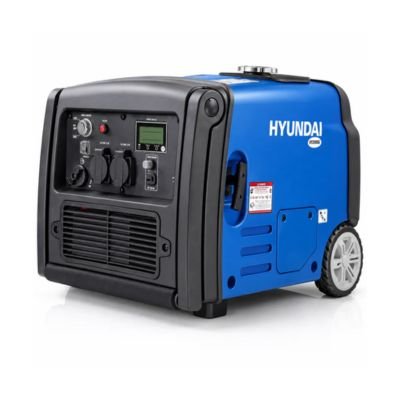
Inverter generators are particularly relevant when the generator will be used to supply modern electronics, battery chargers, lighting, laptops or other equipment that benefits from a stable electrical supply. They generate electricity and electronically condition the output, which can produce a cleaner and more controlled waveform than some conventional generator designs.
Another advantage is that many inverter generators can vary engine speed according to electrical demand. At lighter loads, this can reduce unnecessary fuel consumption and may also make the generator quieter than a conventional machine operating at a fixed engine speed.
For cordless power-tool charging, an inverter generator can therefore be an attractive option when portability, electrical quality and relatively low operating noise are important considerations.
Traditional open-frame generators are often designed around straightforward construction and comparatively high output. They can be suitable for demanding workshop or site applications where portability and low noise are less important than ruggedness, capacity and straightforward operation.
They can also be physically larger and heavier than compact inverter models. Buyers should consider whether the generator will regularly be moved between vehicles, work areas and storage locations before choosing this type.
Dual-fuel generators are designed to operate using two fuel types, commonly petrol and LPG. Their principal attraction is flexibility rather than automatically superior performance. The availability of fuel, expected running conditions, storage requirements and manufacturer specifications all need to be considered.
For occasional emergency use, fuel flexibility can be useful. For regular professional work, however, the most convenient option is often the generator whose fuel supply, operating procedure and maintenance requirements best fit the working environment.
Petrol-powered generators remain a common choice for portable power. They can offer substantial output in a relatively compact package, although fuel storage, ventilation, servicing and safe operation need careful consideration.
Petrol generators should only be operated outdoors or in locations specifically designed for safe generator operation. Carbon monoxide from engine exhaust is dangerous and can accumulate rapidly in enclosed or poorly ventilated spaces.
Diesel generators are generally more associated with heavier-duty applications and prolonged operation. They can make sense where continuous use, durability and higher power requirements are more important than minimum weight.
For simply charging a few cordless tool batteries, a diesel generator may be unnecessarily large. It becomes more relevant when the same generator must support several substantial loads or operate for extended periods.
Generator output is commonly expressed in watts (W) or kilowatts (kW). One kilowatt equals 1,000 watts. However, the number printed on a generator should not be treated as the amount of power that can always be supplied continuously under every operating condition.
Pay close attention to the distinction between continuous or rated output and maximum, peak or starting output. Rated output is the more useful figure when calculating the generator's ongoing load. Maximum output may only be available for a limited period and should not be treated as the normal operating capacity.
Start by listing everything that may operate simultaneously. This could include cordless-tool chargers, site lighting, a battery charging station, a laptop, radio, small compressor or other electrical equipment.
Add the relevant running wattages together, then allow additional capacity for startup loads and practical operating headroom. If the equipment manufacturer provides a starting or surge requirement, use that figure rather than relying solely on the normal running wattage.
For example, a generator intended only to recharge several battery packs has a very different workload from one expected to power chargers while also running a compressor, lighting and a mains-powered saw.
A generator should not necessarily be selected so that its rated output is almost identical to the calculated load. Some reserve capacity can make the system more flexible and reduce the need to operate continuously near its limit.
However, excessive oversizing has disadvantages. A very large generator can be heavier, more expensive, less convenient to transport and inefficient for a consistently tiny load. The objective is a sensible balance between capacity and the actual electrical demands of your tools.
Battery chargers contain electronic components that can be more sensitive to electrical conditions than simple resistive loads. This makes power quality an important consideration when selecting a generator for cordless power-tool batteries.
Look at the generator's published electrical specifications rather than assuming every portable generator produces identical output. Inverter technology can be particularly useful where sensitive electronic equipment is part of the intended load.
Major cordless-tool manufacturers such as Bosch Professional, DeWalt, Makita, Milwaukee, Festool, Metabo and Ryobi offer chargers and battery systems with different electrical requirements. Always check the charger manufacturer's instructions and the generator manufacturer's specifications before connecting equipment.
For equipment intended for use in the United Kingdom, check that the generator provides the correct nominal electrical characteristics for the intended appliances and chargers. UK mains equipment is generally designed around 230V and 50Hz operation.
Do not assume that an imported generator is suitable simply because its wattage appears sufficient. Voltage, frequency, socket configuration, earthing arrangements and relevant manufacturer instructions all matter.
Buyers should also check whether the generator's outlets and supplied accessories are appropriate for UK use. Avoid relying on improvised adapters simply to make incompatible equipment physically connect.
When researching generators for battery chargers, the terms used to describe electrical output deserve attention. Inverter generators are commonly associated with cleaner and more tightly controlled AC output because the electricity is electronically processed before reaching the outlets.
This does not mean every inverter generator is automatically appropriate for every electronic load. Always consult the manufacturer's technical documentation for the specific generator and charger combination.
If your generator will also supply sensitive electronics such as computers, monitors, networking equipment or sophisticated battery-management equipment, output characteristics should be treated as a key buying criterion rather than an optional feature.
One of the most common generator-buying mistakes is comparing models using their maximum wattage alone. A generator advertised with a high peak figure may have a considerably lower rated output.
For cordless-tool charging, the running requirement of the chargers may be relatively predictable. For mixed loads, however, startup demand can become more important. Motors in compressors, pumps and certain mains-powered tools can require substantially more power when starting than when already running.
When comparing models, record both the rated output and the maximum output. A generator with a slightly lower peak number but a stronger continuous rating may be the more useful choice for sustained work.
There is no universal number because chargers vary in input power and charging behaviour. The correct approach is to calculate the combined input requirement of the chargers rather than counting chargers.
A small charger may have a modest electrical demand, while a high-speed charger or multi-battery charging station can draw considerably more. Multiple chargers can also operate at different stages of their charging cycles, meaning actual demand may fluctuate.
Check the input wattage or amperage specified on each charger. Where only amperage is stated, use the electrical specifications supplied by the manufacturer to determine the approximate input requirement. Then add the loads that may operate at the same time.
If the generator is mainly required to recharge one or two cordless tool batteries, a compact portable generator may be sufficient, provided its electrical specifications are compatible with the chargers and there is adequate reserve capacity.
Tradespeople using several battery platforms may need a larger generator if multiple chargers are expected to operate simultaneously. This is especially relevant where high-speed charging is important because fast chargers can place greater demand on the electrical supply.
If the generator will also operate lighting, a small compressor, extraction equipment, heaters or mains-powered tools, calculate the combined load. A generator that appears more than adequate for charging batteries alone may become undersized once additional equipment is connected.
Workshop applications can require considerably more capacity because several motor-driven appliances may be used. In this situation, starting current, extension-cable losses, simultaneous operation and generator protection features deserve particular attention.
Runtime figures should be interpreted carefully. A manufacturer's stated runtime is normally dependent on factors such as fuel capacity, electrical load, engine speed and operating conditions. A generator operating at a light load may consume fuel differently from the same machine operating close to its rated output.
For occasional work, a compact fuel tank may be perfectly practical. For longer jobs, a longer rated runtime can reduce interruptions. Consider how frequently you are realistically prepared to refuel rather than selecting a model based solely on the largest tank.
Fuel efficiency is particularly relevant to cordless-tool charging because chargers may only draw substantial power intermittently. An inverter generator capable of reducing engine speed at low loads can therefore be worth considering where quiet and economical operation are priorities.
Noise can be one of the most important practical differences between generator models. A generator may provide adequate electrical capacity but still be inconvenient if its operating noise is excessive for the intended location.
Inverter generators are often considered where lower noise is desirable, particularly for mobile work, outdoor maintenance and situations where the generator will operate near people. Compare the manufacturer's stated sound measurements and check how the measurement was obtained before comparing numbers from different models.
Noise considerations are also relevant when working near homes, offices, public areas or other occupied buildings. Local rules and site requirements may apply, so users should check the conditions governing generator operation at their location.
A generator can become surprisingly inconvenient if it has to be carried regularly. Weight, dimensions, handles and wheels can therefore be just as important as electrical output.
Before buying, consider the complete journey from storage to the work area. A generator that remains in a vehicle or workshop can tolerate a different weight than one that needs to be carried across a garden, construction site or rural property.
Compact generators are generally easier to position, but smaller dimensions can mean reduced fuel capacity or output. Larger generators may provide greater capacity while requiring more careful transport planning.
Portable generators commonly use recoil starting, electric starting or a combination of both. Recoil systems can be mechanically straightforward, while electric starting can be more convenient on suitable models.
Do not choose an electric-start generator without considering the battery system used to start the engine. If the starter battery is discharged, the availability of an alternative starting method may be valuable.
Clear controls also matter. A well-designed control panel should make it straightforward to identify the power outlets, switches, circuit protection and operating indicators without unnecessary complexity.
Automatic voltage regulation, commonly abbreviated to AVR, is a feature found on many conventional generators. It is designed to help control voltage as electrical demand changes.
AVR should not automatically be treated as equivalent to inverter technology. The two approaches work differently and should be assessed according to the equipment you intend to power. For electronic chargers and sensitive devices, examine the generator's complete output specifications rather than relying on one feature name.
The available outlets should match your intended equipment and accessories. Check the socket types, number of outlets, rated current and any stated protection features before purchasing.
Residual current protection, overload protection and circuit breakers can provide important safeguards, but users still need to follow the generator's operating instructions. Electrical protection does not make unsafe connections or unsuitable extension leads acceptable.
Never exceed the rated capacity of a socket, extension lead or distribution device. If you are uncertain about an installation or temporary electrical arrangement, seek advice from a suitably qualified professional.
Extension leads can introduce additional practical and electrical considerations. Long cable runs can result in voltage drop, while undersized cables can become excessively warm under load.
Choose extension leads with an appropriate current rating and cable size for the intended load and length. Outdoor work requires equipment suitable for outdoor conditions, and connections should be protected from rain, standing water and mechanical damage.
A generator should be positioned so that cables can be routed safely without creating trip hazards or exposing them to vehicles, sharp edges or excessive heat.
Generator electrical arrangements can vary substantially by model. Earthing and bonding requirements should therefore be followed exactly as specified by the generator manufacturer and applicable UK electrical guidance.
Do not modify the generator's electrical system or create improvised connections because a particular socket arrangement is inconvenient. Generator installations that connect to a building's electrical system require particular care and may require a suitably qualified electrician.
Connecting a portable generator directly to a household socket in an attempt to energise a property's wiring is dangerous. This can create serious electric-shock and fire hazards and can place electricity onto circuits that were not designed for that method of supply.
If a generator is intended to provide backup power to a building, the installation should use an appropriate transfer arrangement designed and installed in accordance with applicable electrical requirements by a competent professional.
Petrol and diesel generators produce carbon monoxide as part of engine exhaust. Carbon monoxide is colourless and odourless and can cause fatal poisoning.
Never operate a fuel-burning generator inside a house, garage, shed, basement, vehicle, tent or other enclosed or poorly ventilated area. Opening a door or window does not necessarily make indoor operation safe.
Place the generator outdoors in a suitable location away from doors, windows, vents and other openings through which exhaust could enter an occupied building. Follow the manufacturer's instructions for minimum clearances and ventilation.
Modern cordless tool batteries use sophisticated charging electronics. The charger manages the charging process and communicates with the battery system, so the generator should be viewed as the electrical source for the charger rather than as a direct substitute for the charger itself.
Do not attempt to connect a cordless battery directly to a generator. Use the manufacturer's approved charger or charging equipment and follow its operating instructions.
Compatibility becomes particularly important when using high-capacity batteries, rapid chargers and multi-battery charging stations. Check the charger's input requirements and the generator's rated output before making a purchase.
Generator buyers who already own cordless tools should consider the battery platform as part of the wider equipment ecosystem. Bosch Professional, DeWalt, Makita, Milwaukee, Festool, Metabo, Ryobi and other established manufacturers offer different battery voltages, capacities, chargers and tool ranges.
There is no single best battery platform for every user. Someone already invested in one ecosystem may gain more value from buying additional batteries and compatible chargers rather than switching brands simply to match a particular generator.
For professionals, platform compatibility can also affect downtime. Having a consistent charging system, interchangeable batteries and readily available replacement packs may be more useful than focusing exclusively on individual tool specifications.
Peak wattage is only one part of the specification. Always compare the continuous or rated output as well.
Counting batteries or chargers is not an accurate way to determine generator size. Use the electrical input specifications of the chargers and any other equipment that may run simultaneously.
More power is not automatically better. Excess capacity can add unnecessary weight, fuel consumption, purchase cost and storage requirements.
A generator that is acceptable on a remote worksite may be inconvenient around homes or other occupied areas. Consider noise before committing to a model.
Check the generator's actual weight and dimensions rather than assuming a portable generator is easy to carry.
Fuel requirements affect where and how the generator can be stored. Follow applicable UK safety guidance and the manufacturer's instructions for fuel handling and storage.
An extension lead should be appropriately rated for the load, length and environment. A generator's output rating does not make an undersized cable safe.
Check the generator's electrical-output specifications instead of relying on marketing language alone. This is especially important when supplying chargers and other electronic equipment.
When comparing two or more generators, put their specifications side by side rather than focusing on a single headline feature.
Build quality is difficult to judge from wattage alone. Examine the overall design, frame construction, access to service components, control-panel layout, fuel-system design and the manufacturer's technical documentation.
If a generator will be transported frequently, physical protection becomes especially important. Consider how exposed the control panel and sockets are to knocks and whether handles or wheels are designed to support the generator's operating weight.
For regular professional use, serviceability can be more important than a small difference in headline output. Easy access to filters, oil-fill points and other routine maintenance components can simplify ownership.
A generator is an engine-driven machine as well as an electrical power source, so routine maintenance should not be overlooked. Maintenance requirements vary by model and engine type, making the manufacturer's schedule the most important reference.
Storage conditions can affect reliability. A generator should be kept in an appropriate dry, secure location when not in use, while allowing the engine and exhaust system to cool fully before storage.
Fuel storage deserves particular attention. Follow the manufacturer's recommendations and applicable UK requirements for fuel type, containers, ventilation and storage location. Do not store a fuel-burning generator in a living area.
If the generator is used only occasionally, consult the owner's manual for procedures relating to fuel stabilisation, draining, battery maintenance and periodic starting.
If a generator is going to support a full day's work, avoid discovering maintenance problems after arriving on site. Carry out appropriate pre-use checks in accordance with the owner's manual.
Construction environments place additional demands on portable equipment. Dust, moisture, impact, frequent transportation and long operating periods can all affect the suitability of a particular generator.
For site work, prioritise durability, straightforward controls, sufficient output, sensible portability and appropriate electrical protection. Consider how the generator will be transported, where it will be positioned and how cables will be protected from vehicles and machinery.
Where site rules apply, the generator must also comply with the requirements of the workplace and the equipment being powered.
For garden maintenance, landscaping and property work, portability can be especially important. The generator may need to move between locations while supplying battery chargers, lighting or occasional mains-powered equipment.
A compact inverter generator may be attractive where the workload is relatively modest and low noise is valuable. If the same generator needs to run demanding motor-driven equipment, calculate the startup requirements before deciding on a compact model.
Workshop applications often involve a broader range of loads. In addition to cordless-tool chargers, there may be extraction systems, compressors, lights, bench tools and other electrical equipment.
Make a realistic list of equipment that might operate simultaneously. If motor-driven equipment is included, pay particular attention to starting demand. A generator suitable for battery charging alone may not have sufficient capacity for a workshop's complete electrical load.
If the generator is intended for emergency power, decide exactly which appliances or circuits need to remain operational. Emergency backup is different from powering cordless tool chargers on a worksite.
List essential loads such as lighting, refrigeration, communications equipment or other critical appliances, then determine how they can be supplied safely. A portable generator should never be connected to a property's wiring through an improvised backfeed arrangement.
Customer reviews can be useful for identifying recurring practical issues, but they should not replace technical specifications. Review comments may relate to individual expectations, operating conditions or accessories that differ from your intended use.
When evaluating customer feedback, look for repeated observations about starting behaviour, portability, noise, controls, fuel consumption, durability and ease of maintenance rather than relying on one unusually positive or negative comment.
For technical decisions, prioritise manufacturer documentation and compare independently stated specifications wherever possible.
For a generator whose principal purpose is cordless power-tool charging, the most useful features are not necessarily the ones that produce the largest headline specifications. Stable electrical output, suitable rated capacity, manageable noise, portability and efficient operation can be more valuable.
An inverter design may be particularly attractive for users who regularly charge modern battery systems and also need to operate other electronic devices. For heavier applications, a conventional generator with greater continuous output may make more sense.
The best choice is therefore determined by the complete workload rather than by the generator category alone.
A fuel generator and a battery-based portable power station solve similar problems in different ways. A generator produces electricity using an engine, while a portable power station stores electricity in an internal battery and supplies it through its inverter and outlets.
Portable power stations can be attractive for quiet indoor-adjacent applications where their specific output and operating instructions permit the intended use. They do not produce engine exhaust during operation, but their stored energy is finite and the unit must eventually be recharged.
A fuel generator can provide extended operation as long as suitable fuel is available, but it produces exhaust and engine noise and requires appropriate outdoor operation. For cordless-tool charging, compare both approaches according to required runtime, load, portability, noise, storage and charging opportunities.
If most work is performed close to a reliable mains electricity supply and cordless batteries can be charged between jobs, purchasing a generator may not provide enough practical benefit to justify its cost and maintenance.
Likewise, a small portable power station may be a more convenient solution for occasional low-power charging where the required energy capacity is modest and quiet operation is important.
The best buying decision is not always to purchase a generator. First establish whether independent power is genuinely needed and how often it will be used.
Professional users should place greater emphasis on serviceability, transport durability, runtime, electrical capacity and the manufacturer's maintenance support. Frequent use increases the importance of reliability and convenient routine servicing.
Occasional users may place more value on compact dimensions, simple controls, easy storage and reasonable running requirements. A large professional-grade generator can be unnecessary if it will only be used occasionally for light charging duties.
A useful way to approach the buying decision is to create three load scenarios: normal use, busy use and maximum realistic use.
Select a generator with a rated output that provides suitable capacity for the maximum realistic operating scenario while retaining sensible headroom. There is little value in sizing a generator around equipment that will never realistically be used together.
The best generator depends on the chargers and equipment being powered. For cordless-tool charging, prioritise compatible voltage and frequency, suitable continuous output, stable electrical performance, portability and an appropriate noise level. An inverter generator can be particularly attractive for users who need a clean and controlled supply for chargers and electronics, while higher-output conventional models can be more appropriate for demanding mixed loads.
Charger input requirements vary by manufacturer, battery platform, charger type and charging speed. Check the electrical information printed on the charger or provided in its documentation rather than assuming all chargers consume the same amount of power.
A suitable generator can supply power to a compatible DeWalt charger when the generator's electrical output meets the charger's requirements. Check the specific charger documentation and generator specifications before use.
Makita battery chargers require an appropriate electrical supply. A generator may be used as the supply where its voltage, frequency, output and electrical characteristics are compatible with the charger and the manufacturer's instructions permit the intended use.
Milwaukee chargers can be powered from a suitable electrical generator when the generator provides compatible electrical characteristics and sufficient capacity. Always check the specifications for the exact charger and generator.
They can be a strong choice because inverter technology is designed to provide controlled electrical output and can also offer useful advantages in portability and operating noise. However, suitability should still be confirmed from the generator and charger specifications.
A 2kW generator may be suitable for some charging and lighter-duty applications, but the answer depends on the combined load and starting requirements. A 2kW rating should not be treated as sufficient for every collection of power tools.
A 3kW generator can provide substantial capacity for many cordless-tool charging setups, but the required size should still be calculated from the actual charger and equipment loads. Additional mains-powered tools can significantly change the required capacity.
Rated power represents the generator's normal continuous output capability, while peak or maximum power generally describes a higher output available for a limited period or during suitable conditions. Rated output is normally the more important figure when planning sustained loads.
No. Fuel-burning generators produce carbon monoxide and must not be operated inside homes, garages, sheds, tents, vehicles or other enclosed or poorly ventilated areas. Follow the manufacturer's outdoor-placement and clearance instructions.
You should never use an ordinary household socket as an improvised method of backfeeding a property. This can create serious electrical hazards. Proper generator backup installations require an appropriate transfer arrangement and professional installation where applicable.
No. A generator should be matched to the intended load. Excessive capacity can increase weight, fuel consumption, storage requirements and cost without providing a meaningful advantage for a light-duty charging setup.
Start with rated output and electrical compatibility, then compare generator technology, noise, portability, fuel type, runtime, socket configuration, protection features, maintenance requirements and overall suitability for your working environment.
Before choosing from a selection of top-rated generators, use the following checklist to narrow down the options that genuinely fit your needs:
A useful independent buying guide should look beyond star ratings and headline wattage. The most meaningful comparison considers whether a generator is appropriate for the intended electrical load, whether its output matches the connected equipment, how practical it is to transport, how it is fuelled, how loudly it operates and how straightforward it is to maintain.
For cordless power-tool users, the charging ecosystem is equally important. A generator should complement the battery platforms already used rather than being selected in isolation. Compare charger input requirements, simultaneous charging needs and any additional site equipment before deciding how much generator capacity is genuinely necessary.
Product specifications, retailer pricing, stock status and customer feedback can change over time. Before making a purchase in the UK, verify the current specification and availability for the exact model and configuration you are considering.