

♥ Wishlist
Compare 14 verified Cordless Angle Drills products in United Kingdom. Reviews, ratings, pros, cons and buying advice updated for October 2026.


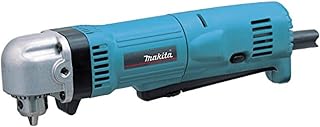


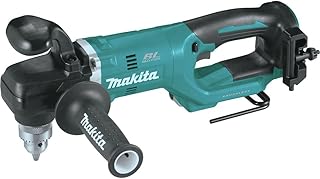

A cordless angle drill is designed for situations where a conventional drill is too long, awkward or difficult to position. The right-angle layout places the chuck and bit at approximately 90 degrees to the motor and handle, making the tool particularly useful inside cabinets, between joists, beneath worktops, around pipework and in other restricted areas.
For UK buyers, the most important decision is not simply which drill has the highest voltage or torque figure. A compact 12V angle drill can be a better choice than a larger 18V model when access and control are the priorities, while a heavy-duty right-angle drill is more appropriate for large holes in structural timber and demanding trade applications.
The recommendations and comparisons on this page should therefore be judged by the type of work involved, the available clearance, drilling diameter, battery platform, tool weight, chuck design and expected frequency of use. Specifications can vary between individual variants, kits and regional models, so check the exact model designation before purchasing.
A cordless angle drill is a battery-powered drill designed with a compact or right-angle configuration. Instead of holding the motor directly behind the chuck like a conventional drill, the mechanism redirects power through an angled gear arrangement so the drilling accessory can reach areas where a standard drill body would interfere with surrounding components.
There are several designs within this category. Some are genuinely compact right-angle drills with a fixed 90-degree head, while others use a pivoting head that can be positioned at several angles. Heavy-duty right-angle drill drivers may have substantially larger motors, metal gear housings and high-capacity battery systems because they are intended for large-diameter drilling rather than occasional DIY work.
This distinction matters when comparing products described as an “angle drill”. A compact drill for cabinet installation is not intended to perform the same work as a large professional right-angle drill used for plumbing, electrical installation or structural timber.
One of the first specifications worth checking is whether the head is fixed or adjustable.
A fixed right-angle head provides a straightforward configuration for drilling in confined spaces. There are fewer moving components around the head, and the shape can be particularly predictable when repeatedly drilling at 90 degrees.
This arrangement is well suited to users who already know that most of their work requires a right-angle configuration. It can also be preferable where the smallest practical head profile is more important than versatility.
A pivoting-head design provides additional flexibility because the head can be repositioned to suit different working angles. This can be useful when the available clearance changes from one job to another.
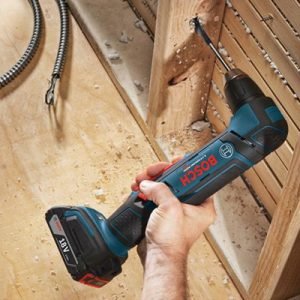
For example, the Bosch Professional GWB 12V-10 uses a five-position pivoting head and a 12V battery system. Bosch specifies a no-load speed of up to 1,300 rpm, 3 Nm soft torque and 11 Nm hard torque, with a maximum drilling diameter of 10 mm in both wood and steel according to its published specifications. :contentReference[oaicite:0]{index=0}
A pivoting mechanism should nevertheless be evaluated for ease of adjustment, locking security and overall tool balance rather than simply the number of available positions.
Compact 12V models are generally attractive when low weight, manoeuvrability and access are more important than maximum drilling capacity. They are particularly relevant to cabinetmakers, kitchen fitters, electricians, installers and DIY users working with smaller holes and fasteners.
The Bosch Professional GWB 12V-10 is a useful example of this category. Its published specification lists a 12V battery system, 1.2 kg weight excluding the battery specification shown by Bosch, 0–1,300 rpm speed range and maximum screw diameter of 6 mm. :contentReference[oaicite:1]{index=1}
An 18V platform generally offers more headroom for demanding applications. However, an 18V right-angle drill can be considerably larger and heavier than a compact 12V model.
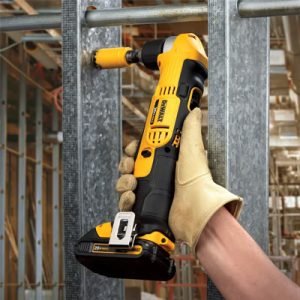
For buyers already invested in an 18V ecosystem, platform compatibility can make an 18V angle drill particularly attractive because the same batteries and chargers may serve multiple tools. DeWalt XR, Makita LXT, Bosch Professional 18V and Milwaukee M18 are examples of established professional cordless ecosystems.
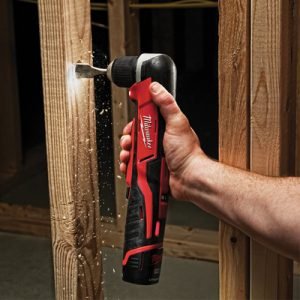
Heavy-duty models occupy a different part of the market. They are intended for substantial drilling operations and can be much heavier than compact installation drills. Milwaukee's M18 FUEL SUPER HAWG 2-Speed Right Angle Drill Driver Gen II, for example, is designed around the M18 battery platform and includes a mechanical clutch, all-metal gear case, 13 mm keyed chuck and two-speed operation. Milwaukee also specifies compatibility with all M18 batteries. :contentReference[oaicite:2]{index=2}
Do not automatically interpret a high-power specification as an advantage. If most of the work involves small holes inside cabinets, a large professional right-angle drill may be unnecessarily bulky.
Brushless motors have become common in professional cordless power tools because they eliminate replaceable carbon brushes and can provide efficient electronic control of the motor.
For frequent users, brushless construction can be an important buying consideration, particularly when the drill is expected to perform repeated work under load. It can also be associated with more advanced electronic protection and power management systems, depending on the model.
Brushed motors should not automatically be dismissed for occasional DIY work. The more useful question is whether the complete tool offers the required drilling capacity, ergonomics, battery compatibility and durability for the intended workload.
Torque is frequently used to compare cordless drills, but a larger torque number does not automatically make an angle drill better for every application.
Torque describes the rotational force available at the spindle. High torque is useful when drilling large holes, driving larger fasteners or working with demanding materials. Lower torque can be perfectly adequate for pilot holes, cabinetry, electrical installation and general light-duty drilling.
Manufacturers may publish different torque measurements, such as soft torque and hard torque, and these figures should not be treated as directly interchangeable between brands. Testing methods, operating conditions and specifications can differ.
When comparing two models, look at torque alongside speed range, chuck capacity, maximum recommended drilling diameter, gear selection and battery platform rather than using torque as the sole ranking criterion.
A variable-speed trigger gives the operator control over drilling speed, but a two-speed gearbox can provide a more meaningful difference in practical use.
A drill with a very high maximum rpm is not necessarily superior if the tool lacks the torque or control needed for the accessories you intend to use.
The chuck is one of the most important components to inspect before buying an angle drill because it determines which accessories the tool can accept and how conveniently they can be changed.
A keyless chuck allows the bit to be tightened by hand. This is convenient for installation work where accessories need to be changed frequently.
A keyed chuck uses a chuck key to tighten the jaws. It can provide a strong grip and is common on larger, heavy-duty right-angle drills.
For example, Milwaukee specifies a 13 mm keyed chuck on the M18 FUEL SUPER HAWG Gen II. :contentReference[oaicite:3]{index=3}
A 10 mm, 13 mm or other chuck rating should be considered alongside the manufacturer's recommended accessory sizes. Chuck capacity does not mean the drill is automatically suitable for drilling a hole of the same diameter in every material.
Maximum drilling diameter is one of the most useful specifications when comparing cordless angle drills. However, always check the material associated with the figure.
A manufacturer may specify different capacities for wood, steel or other materials. A large wood-boring capacity does not imply that the same tool is suitable for drilling an equally large hole through steel.
For example, Bosch specifies the GWB 12V-10 for drilling up to 10 mm in wood and 10 mm in steel, while its published guidance also identifies screw-driving applications up to 6 mm. :contentReference[oaicite:4]{index=4}
Heavy-duty right-angle drills can support substantially larger accessories, but the accessory, material, drilling technique and manufacturer's instructions must all be considered before attempting large-diameter work.
Battery capacity is normally expressed in ampere-hours (Ah). In simple terms, a higher Ah battery can provide more stored energy, although actual runtime depends heavily on the workload, accessory, material, drilling diameter and tool electronics.
For a compact angle drill used overhead or inside cabinets, adding a very large battery can undermine the ergonomic advantage of the small drill body. For high-load drilling, however, the additional capacity can be worthwhile.
Battery compatibility is one of the strongest reasons to choose a particular brand. If you already own several cordless tools, buying an angle drill from the same platform can reduce the need for another charger and separate battery family.
Major UK professional ecosystems include Bosch Professional 12V and 18V, Makita LXT and XGT, DeWalt XR, and Milwaukee M12 and M18. Ryobi ONE+ can also be relevant for DIY users who already own compatible tools.
Check the exact battery system rather than assuming that batteries from the same brand are interchangeable. Voltage families can be separate, and physical compatibility does not necessarily extend across every product generation or platform.
Cordless angle drills are commonly offered either as a bare tool or as a kit containing batteries and a charger.
A bare tool is often the logical choice when you already own compatible batteries. It can also make sense when building a multi-tool collection around a single battery ecosystem.
A kit can be more convenient for a first-time buyer because it may include one or more batteries, a charger and a storage case. Compare the contents carefully because two listings for what appears to be the same drill can contain substantially different accessories.
Before comparing prices, check whether the listing includes the battery, charger, case, side handle and other accessories. “Tool only” and “kit” prices should not be treated as equivalent.
Weight becomes particularly important with angle drills because these tools are often used in awkward positions. A drill that feels manageable at bench height can become tiring when held overhead or at arm's length.
Look at both bare-tool weight and battery-inclusive weight. The battery can significantly change the balance of a compact drill.
Also consider where the battery is positioned. A compact battery mounted beneath the handle can feel very different from a larger high-capacity pack attached to the base of a professional drill.
For an angle drill, overall dimensions can be more important than headline power.
Measure the space in which you expect to work and consider the distance between the drilling point and the nearest obstruction. The relevant dimension is not simply the total length of the tool; head depth, chuck projection, battery position and handle clearance can all determine whether the drill will physically fit.
This is especially important for cabinet installation, under-sink work, electrical boxes, joist drilling and work inside narrow service spaces.
Look for a handle that permits a secure grip without forcing the wrist into an extreme position. A slim grip can be advantageous on compact models, while larger high-torque drills may use additional handles because the operator needs more leverage.
Useful ergonomic features can include:
The Bosch Professional GWB 12V-10, for example, uses a slim soft-grip handle and an extended-position trigger intended to improve control in restricted working positions. :contentReference[oaicite:5]{index=5}
Integrated LED lighting is especially useful for angle drills because confined work areas can be poorly illuminated. A light positioned close to the chuck can help illuminate the drilling point without requiring an additional work lamp.
Do not treat an LED as a substitute for proper workplace lighting. It is best regarded as a convenience and visibility feature rather than a primary safety system.
Modern cordless drills can include electronic protection against conditions such as overload, excessive battery discharge or overheating. The precise functions vary between manufacturers and models.
Some professional systems also use electronic communication between the battery and tool to manage performance under load. When comparing advanced cordless platforms, examine the manufacturer's description of these systems rather than assuming that every model provides identical protection.
The Bosch GWB 12V-10, for example, includes Electronic Cell Protection and a battery charge-level indicator among its listed equipment. :contentReference[oaicite:6]{index=6}
A clutch can help limit the amount of torque transmitted during screwdriving. This can reduce the likelihood of overdriving fasteners or damaging softer materials.
Heavy-duty right-angle drills may use a mechanical clutch specifically to manage stall conditions under high loads. Milwaukee's M18 FUEL SUPER HAWG Gen II, for example, lists a mechanical clutch among its features. :contentReference[oaicite:7]{index=7}
For precision screwdriving, however, the availability and behaviour of multiple clutch settings can be more relevant than the presence of a high-power mechanical clutch.
Wood is one of the principal applications for right-angle drills. Compact models can handle smaller holes, while higher-powered tools are better suited to large auger, spade or self-feed bits where the manufacturer's specifications permit their use.
When drilling large holes in timber, use the appropriate bit and avoid forcing the drill beyond its rated capacity. Large accessories can create substantial resistance and reaction torque.
Metal drilling places different demands on a cordless drill. Speed control, appropriate drill bits, cutting conditions and adequate lubrication where applicable become important considerations.
Do not judge a drill's metal-drilling ability solely from its wood capacity. Always check the manufacturer's specified metal capacity and accessory requirements.
Plastic and composite materials can generally require controlled drilling to avoid melting, cracking or excessive heat. A variable-speed trigger is useful because it allows the operator to adapt drilling speed to the material.
Cabinetry often creates precisely the kind of restricted access where a right-angle drill is valuable. A compact model can make it easier to drill through cabinet components, install fittings and work around existing structures.
Electricians may encounter tight spaces where a conventional drill body is difficult to position. The compact configuration can be useful for drilling through timber framing and other approved materials when the tool and accessory are appropriately rated.
Pipework and service spaces can create awkward access conditions. A suitable right-angle drill can help with timber drilling during installation work, but the drill should never be selected solely because it fits the space; power, bit size and material capacity still need to match the task.
Joiners can benefit from compact angle drills when working inside furniture, cabinetry and other confined timber assemblies.
High-power right-angle drills are particularly relevant when large holes are required in timber. This is where the distinction between a compact installation drill and a heavy-duty framing-oriented drill becomes particularly important.
For occasional home use, a compact cordless angle drill can be worthwhile if restricted-access drilling is a recurring requirement. If most DIY drilling takes place in open areas, a conventional cordless drill or combi drill may provide better overall versatility.
A conventional cordless drill is normally the better all-purpose choice when access is unrestricted. It can handle drilling, screwdriving and, in the case of a combi drill, light masonry work.
A right-angle drill becomes more compelling when physical clearance is the primary problem.
Right-angle attachments can sometimes convert a conventional drill into a tool capable of reaching restricted areas. They may be useful for occasional light-duty access problems.
However, an integrated right-angle drill is purpose-built around the angled transmission and ergonomics. For frequent or demanding work, a dedicated tool can provide a more appropriate overall design.
Attachments should also be checked for their rated speed, torque, chuck or bit interface and compatibility with the host drill. Never assume that an attachment automatically makes a standard drill suitable for high-load right-angle drilling.
| Feature | Compact angle drill | Heavy-duty right-angle drill |
|---|---|---|
| Primary priority | Access and manoeuvrability | Power and large-hole drilling |
| Typical battery class | Often 12V | Often 18V or higher-power systems |
| Weight | Generally lower | Generally higher |
| Best suited to | Cabinetry, installation and light drilling | Structural timber and demanding trade work |
| Chuck design | Often compact keyless formats | May use larger keyed chucks |
| Large-hole capability | Limited by design | Designed for larger accessories on suitable models |
Brand selection is important because the battery platform can affect the cost and practicality of expanding your cordless tool collection.
Bosch Professional offers compact and higher-power angle-drill options. Its GWB 12V-10 is particularly relevant to users prioritising compact dimensions and restricted-space access, while the company's current angle-drill range also includes 18V professional models. :contentReference[oaicite:8]{index=8}
Makita is a major professional cordless-tool brand in the UK, with established battery platforms and a broad selection of drilling equipment. Buyers should compare the exact angle-drill model rather than assuming that every Makita cordless drill is designed for the same restricted-access applications.
DeWalt's XR cordless ecosystem is widely used for professional and trade applications. If you already own compatible XR batteries and chargers, platform compatibility may be an important factor when considering a DeWalt right-angle drilling solution.
Milwaukee is particularly relevant for professional users looking at heavy-duty right-angle drilling. Its M18 FUEL SUPER HAWG Gen II is designed for demanding applications and combines an M18 battery platform with a brushless motor, mechanical clutch, two-speed operation and a 13 mm keyed chuck. :contentReference[oaicite:9]{index=9}
Ryobi can be worth considering for DIY users who already use the ONE+ battery platform. The key advantage is the wider ecosystem rather than choosing a tool based solely on headline specifications.
Einhell's Power X-Change ecosystem is another option for home users who want multiple cordless tools sharing batteries. As with every brand, check the individual tool's drilling capacity and physical dimensions before buying.
More torque can be useful, but it often comes with additional size and weight. A high-power drill can be a poor choice for delicate installation work.
For an angle drill, physical size is often the reason for buying the tool in the first place. Check head dimensions and clearance rather than focusing exclusively on voltage.
A bare drill without a battery cannot be compared directly with a complete kit containing batteries and a charger. Check exactly what is included.
Battery systems can differ by voltage class and product platform. Confirm compatibility before purchasing a bare tool.
A drill's maximum chuck capacity does not automatically mean it should be used with every accessory that physically fits. Follow the manufacturer's recommended accessory and drilling capacities.
Runtime and power are valuable, but excessive weight can become a major disadvantage during repeated overhead or awkward-position drilling.
Customer reviews can reveal useful information about ergonomics, packaging and everyday usability, but ratings do not replace manufacturer specifications. A drill can receive excellent feedback while still being unsuitable for your particular material or drilling diameter.
Use a consistent checklist when comparing several models:
For occasional household work, prioritise manageable weight, compact dimensions, a reliable chuck, straightforward controls and a battery platform that you can realistically use for other tools.
There is little benefit in paying for an exceptionally powerful right-angle drill if your work consists primarily of small holes and screwdriving in cabinets. A compact 12V tool can be easier to control and more comfortable to use.
Professional users should place greater emphasis on workload, battery availability, durability, ergonomics, serviceability, accessory compatibility and long-term platform support.
For repeated large-hole drilling, a heavy-duty 18V right-angle drill can make considerably more sense than a compact installation model. For electricians, kitchen fitters and joiners working predominantly in restricted spaces, compact dimensions may be more valuable than maximum power.
If you only occasionally encounter a confined space, buying a dedicated angle drill may not be the most economical solution. A good cordless combi drill can cover drilling, screwdriving and light masonry work while a right-angle attachment may address occasional access problems.
A dedicated angle drill becomes easier to justify when restricted access is a frequent part of your work and the limitation of a conventional drill repeatedly slows down installation.
Read the manufacturer's instructions before operating the tool and use accessories that are appropriate for the drill and material.
Extra care is necessary when drilling in walls, floors, ceilings and structural components because concealed services may be present. If the location or structural implications of a hole are uncertain, obtain appropriate professional advice before drilling.
Dust and debris can accumulate around motor ventilation openings. Keep these areas clean according to the manufacturer's maintenance instructions.
Check that the chuck operates correctly and that accessories are held securely. If the chuck develops excessive play or fails to grip accessories properly, stop using the tool until the issue has been assessed.
Use the manufacturer's recommended charger and battery system. Avoid storing batteries in unsuitable temperatures or conditions and follow the battery manufacturer's storage guidance.
Damaged, bent, excessively worn or unsuitable drill bits can reduce performance and increase the risk of poor drilling results. Replace accessories when they are no longer fit for purpose.
After dusty work, clean the exterior using the method recommended by the manufacturer. Avoid introducing liquids into the motor, battery or electronic components.
Runtime figures published by manufacturers should be treated as application-dependent rather than universal. Drilling large holes places substantially different demands on a battery from driving small screws.
The phrase “top rated” can refer to customer ratings, editorial rankings, specifications or a combination of factors. These are not interchangeable.
A model with excellent customer feedback may be ideal for lightweight installation work but unsuitable for a professional who needs to drill large timber holes every day. Conversely, a powerful trade-oriented model may be unnecessarily expensive and heavy for occasional household use.
A more useful buying approach is to identify the job first and then compare the models that meet the required specifications.
When checking verified customer reviews, look for comments that relate specifically to your intended application.
Ignore reviews that clearly concern a different model, variant or accessory bundle. Product listings can sometimes group related versions together, so verify the exact model number before relying on review details.
Value does not necessarily mean choosing the lowest purchase price. Consider the total cost of ownership, including batteries, chargers and accessories.
If you already own several tools from one battery platform, a bare angle drill can potentially be more economical than starting another battery system. Conversely, if you are buying your first cordless tool, a complete kit may provide better practical value if it contains everything required for immediate use.
Before purchasing, compare today's prices across reputable UK retailers and check the exact package contents. Promotions can change, so a previously expensive kit may sometimes become more competitive than a bare-tool alternative.
There is no single best model for every UK buyer. The best choice depends on access, drilling diameter, material, battery platform, weight and workload. Compact 12V models are often more appropriate for restricted installation work, while high-power 18V right-angle drills are better suited to demanding large-hole applications.
They can be worthwhile if you regularly drill in confined areas where a conventional cordless drill is difficult to position. If restricted access is rare, a conventional cordless drill may provide better overall versatility.
For compact drilling and screwdriving tasks, 12V can be entirely appropriate. The suitability depends on the manufacturer's specified drilling capacity and the accessories being used. Heavy-duty large-hole drilling generally calls for a more powerful tool.
Not necessarily. An 18V model can offer greater power, but a 12V model may be lighter and easier to manoeuvre in tight spaces. Choose according to the application rather than voltage alone.
Brushless motors are attractive for frequent users because they avoid conventional motor brushes and are commonly paired with sophisticated electronic control systems. However, the complete specification and intended workload matter more than the motor label alone.
Some can. Check the manufacturer's specified metal-drilling capacity, accessory requirements and operating speed. Do not assume that a drill's wood-drilling capacity applies equally to steel or other metals.
Some heavy-duty right-angle drills are specifically designed for large-diameter timber drilling. Compact angle drills are generally intended for smaller holes, so always check the manufacturer's maximum drilling diameter for wood and the permitted accessory types.
In power-tool terminology, the phrases are often used interchangeably. Both generally describe a drill configured so that the chuck is positioned at approximately 90 degrees to the main motor axis. Individual designs can differ considerably in size, power and head adjustment.
A bare tool can be a good choice if you already own compatible batteries and a charger. If you are entering a new battery platform, compare the total cost of the tool, batteries and charger before deciding.
There is no universal best capacity. Smaller packs reduce weight and can improve manoeuvrability, while larger packs provide more stored energy for demanding applications. Match battery capacity to the workload and the balance of the tool.
Yes, provided the model is designed for the intended professional application. Compact professional drills can be excellent for installation work, while heavy-duty right-angle drills are available for demanding timber and trade applications.
Prioritise a compact head, low weight, good visibility of the drilling point, easy controls, a suitable chuck and a battery that does not make the tool unnecessarily bulky. A pivoting head can also be useful when working at changing angles.
Very important. The chuck determines compatible accessory sizes and affects convenience and grip. A compact keyless chuck may be preferable for frequent accessory changes, whereas heavy-duty drills can use keyed chucks for demanding applications.
You can, but it may not be the most versatile choice. A conventional cordless drill or combi drill is usually more suitable as a general-purpose household tool. A dedicated angle drill is primarily valuable when restricted access is a recurring requirement.
Before choosing a cordless angle drill, confirm these points against the exact model you intend to buy:
The strongest cordless angle drill for your needs is the one whose physical design and specifications match the work you actually perform. For tight cabinetry and installation tasks, compactness, weight and control can matter more than maximum torque. For large holes in timber, power, gearing, chuck capacity, battery capacity and reaction-torque management become much more important.
When comparing the top-rated cordless angle drills available in the UK, start with the job rather than the brand. Shortlist models that fit the available space, meet the required drilling capacity and work with a battery system you are comfortable maintaining. Then compare the exact specifications, package contents, customer feedback and current retailer pricing before making a purchase.
For 2026 buying decisions, specifications should always be checked against the exact model and kit being considered because manufacturers can update product ranges, accessories and package configurations. A careful comparison of dimensions, performance, battery compatibility and intended application is ultimately more useful than choosing a drill simply because it carries a high rating.