

♥ Wishlist
Compare 19 verified Milwaukee Power Tool Combo Kits products in United Kingdom. Reviews, ratings, pros, cons and buying advice updated for October 2026.


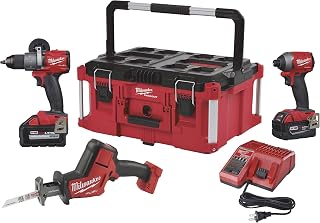


Milwaukee power tool combo kits can be an efficient way to build a cordless workshop because several tools can share the same battery platform. However, the number of tools in a kit should not be the only consideration. A five-piece kit with the right core tools, useful batteries and a suitable charger can be a better purchase than a larger bundle containing tools you rarely use.
For UK buyers, the most important comparison points include the Milwaukee battery platform, tool voltage, brushless motor technology, battery capacity, included accessories, charger type, storage solution, intended workload and the distinction between professional-grade equipment and tools aimed at lighter applications. It is also worth checking exactly what is included in the box because apparently similar combo kits can differ substantially in batteries, cases and accessories.
The first decision is whether the kit should be based around Milwaukee M18, Milwaukee M12, or a combination of platforms. M18 is the larger 18V system and is generally the more versatile choice for demanding drilling, fastening, cutting and construction work. M12 is a compact 12V platform designed around smaller, lighter tools and is particularly useful where access, weight and portability matter.
Choosing a platform first prevents one of the most common cordless-tool buying mistakes: purchasing individual tools without considering battery compatibility. Once a compatible battery and charger are already owned, subsequent bare-tool purchases can sometimes make more sense than repeatedly buying batteries and chargers.
Battery capacity is not simply a specification to compare by itself. A higher-capacity battery can provide greater energy storage, but it may also add weight and physical bulk. For an impact driver used overhead or a compact drill used repeatedly during installation work, a smaller battery can make the tool considerably easier to handle. For high-load saws, grinders or other demanding equipment, additional battery capacity can be more valuable.
When comparing Milwaukee combo kits, examine both the number and type of batteries supplied. Two batteries can be more useful than one if the work requires continuous operation, because one can be charging while the other is in use. Equally, a kit with several small batteries may not be the best choice for applications that place sustained demands on high-output tools.
A common marketing approach is to emphasise the number of pieces included. A six-tool package sounds better than a four-tool package, but the extra tools only add value if they replace tools you would otherwise need to buy separately.
For many UK tradespeople and serious DIY users, a useful starter combination may revolve around a drill driver, impact driver, reciprocating saw or circular saw, and work light. Other users may get more value from an angle grinder, SDS-plus rotary hammer, multi-tool or compact installation tool.
Before choosing a large bundle, make a list of the jobs you actually perform. If three of the included tools would spend most of their time unused, a smaller kit may provide better overall value.
A drill is often the foundation of a cordless tool collection. A combi drill can provide drilling, screwdriving and hammer-drilling functions, making it useful for general maintenance and installation work. When comparing models, consider chuck size, speed ranges, torque control, physical dimensions, grip, weight and whether the tool is brushless.
For masonry drilling, a combi drill can be useful for lighter tasks, but users regularly drilling substantial quantities of masonry should consider whether an SDS-plus rotary hammer would be a more appropriate dedicated tool.
An impact driver is designed primarily for fastening and driving applications. Its compact nose and impact mechanism can make it particularly useful for long screws, structural fixings and repetitive fastening.
Do not automatically treat an impact driver as a replacement for a drill. The two tools perform overlapping but different roles. A drill generally offers more control for conventional drilling and delicate fastening, while an impact driver is particularly useful when high fastening performance and compact dimensions are priorities.
A cordless circular saw can significantly expand the usefulness of a combo kit for timber cutting and site work. Important specifications include blade diameter, maximum cutting depth, bevel adjustment, cutting visibility, ergonomics and compatibility with the battery platform.
For UK users working with sheet material, framing timber, flooring or general construction materials, consider the thicknesses and materials normally encountered rather than selecting a saw solely because it is included in a larger kit.
Reciprocating saws are designed for fast, rough cutting and demolition-oriented applications. They can be useful for cutting timber, pipe, plastics and other materials when a highly finished cut is not the main objective.
When comparing reciprocating saws, look at stroke length, variable-speed control, trigger response, blade-changing mechanism, vibration management and overall balance. Blade selection is equally important because the correct blade can have a major effect on cutting performance and finish.
An SDS-plus rotary hammer is worth considering when masonry drilling and light chiselling are regular requirements. It is fundamentally different from a conventional combi drill because its mechanism is designed specifically for hammer drilling and related masonry applications.
If a combo kit includes both a general-purpose drill and an SDS tool, the combination may be more useful for construction work than a kit containing several overlapping drilling and fastening tools.
An angle grinder can add cutting, grinding and surface-preparation capability to a cordless tool collection. Before choosing one, consider disc diameter, power requirements, guard adjustment, spindle locking, switch design and battery demands.
Because grinding and cutting can place significant loads on a cordless platform, battery selection becomes especially important. Buyers should also account for the cost and type of compatible discs, guards and personal protective equipment rather than treating the bare grinder as the complete setup.
An oscillating multi-tool is one of the most versatile additions to a cordless collection. It can be used for plunge cuts, flush cuts, scraping and detail work when paired with suitable accessories.
The best choice depends heavily on accessory compatibility and ergonomics. A tool that is comfortable to control can be more useful for detailed work than a larger tool whose additional output is rarely required.
Brushless motors are an important consideration when comparing modern cordless tools. Brushless motor technology eliminates conventional motor brushes and can support efficient operation, electronic control and reduced mechanical wear associated with brushes.
That does not mean every buyer needs the most advanced brushless tool available. A homeowner performing occasional light-duty work may prioritise price, compact size and a useful battery bundle. A professional using tools for extended periods may place greater importance on efficiency, durability, thermal management and sustained performance.
When comparing two Milwaukee kits, check whether the individual tools use brushless motors rather than assuming that every tool in a large bundle has the same motor technology.
A combo kit with multiple batteries can be particularly useful when several tools are used throughout the day. Battery quantity should be evaluated alongside capacity, because three compact batteries do not necessarily provide the same working pattern as two higher-capacity batteries.
Always verify the exact Milwaukee battery family required by each tool. M12 and M18 batteries are different systems, and purchasing a tool because it carries the Milwaukee name does not automatically mean that it will accept batteries from another Milwaukee platform.
Consider where and how the batteries will be charged. A professional working away from a workshop may value faster charging and multiple batteries, while a home user may be perfectly comfortable charging batteries between projects.
Where a kit contains several tools, check whether the supplied charger is appropriate for the batteries included and whether the package contains one charger or multiple charging solutions.
Some Milwaukee tools can benefit from batteries designed to deliver higher output. These batteries can be especially relevant to demanding tools, although increased capability can come with additional weight and cost.
Do not automatically buy the largest battery available for every tool. Compact batteries can make drills, impact drivers and other handheld equipment easier to manoeuvre, particularly during overhead or repetitive work.
M18 combo kits are often the most logical starting point for users who want one broad cordless platform for general construction, woodworking, maintenance and demanding DIY applications.
They can make particular sense when the tool collection is expected to grow over time. Milwaukee has a broad M18 ecosystem, so a buyer who starts with a carefully selected kit can potentially expand with additional bare tools rather than changing platforms later.
However, the right M18 kit depends on the user's work. A carpenter may prioritise drilling, fastening, cutting and trim-related tools, while a builder may place greater emphasis on SDS equipment, saws and high-output batteries.
M12 tools can be an excellent choice when compact dimensions and low weight are more important than maximum output. They can be particularly convenient for installation, service, maintenance and confined-space tasks.
For buyers who already own M12 equipment, an M12 combo kit can also provide an efficient way to add complementary tools without introducing another battery platform.
For heavier construction applications, however, carefully compare the requirements of the specific tool rather than assuming a compact platform can replace every M18 application.
A useful package should be assessed by the complete contents rather than its headline tool count. Before buying, check the retailer's current product listing and verify every item included.
Storage can become surprisingly important once a cordless collection grows. A kit that includes an appropriate case or modular storage solution may be easier to transport and organise than a collection of loose tools and batteries.
Professionals travelling between UK jobs should consider how the tools will be carried, protected and accessed. Home users should consider whether the supplied storage fits existing shelving, workshop cabinets or vehicle storage.
Where a kit does not include a preferred storage solution, compare the cost and practicality of adding suitable storage separately.
Milwaukee and DeWalt are both major names in professional cordless tools. The better choice is rarely determined by brand reputation alone. Compare the battery platform, tools you expect to add later, availability of specialist equipment, ergonomics and the total cost of building the collection.
Makita also offers extensive cordless tool ecosystems. Buyers deciding between Milwaukee and Makita should compare equivalent tools rather than comparing brands at a purely cosmetic level. Battery strategy is particularly important because committing to one platform can influence future purchases.
Bosch Professional is another established option for UK users. When comparing a Bosch Professional bundle with Milwaukee, look at the exact specifications of the tools, battery capacities, charger arrangements and the range of future tools available within the selected platform.
Ryobi is often considered by homeowners and DIY users who value a broad cordless ecosystem. Milwaukee is positioned strongly toward professional and demanding applications, but the correct choice depends on workload rather than the prestige of the brand name. Someone completing occasional household projects may have different priorities from a full-time tradesperson.
The cheapest kit is not necessarily the best-value kit. Instead, calculate the practical value of the package by considering the individual tools you would otherwise need, the batteries and charger, the accessories and the likelihood that every included component will be used.
A useful comparison method is to divide the kit into three categories: essential tools, useful extras and tools you would probably never purchase independently. Give the greatest weight to the first category.
It is also worth comparing a complete kit with buying selected tools individually. A larger bundle can look attractive while offering poor value if its additional tools are rarely useful. Conversely, a smaller bundle may become expensive if adding the missing tools, batteries and charger separately costs substantially more.
More tools do not automatically mean better value. Prioritise the tools required for your actual workload.
Tool count means little if the battery setup does not suit the workload. Check capacity, quantity, charging requirements and expected runtime.
Owning both M12 and M18 can be perfectly sensible, but doing so without understanding the differences can increase the number of batteries and chargers required.
Voltage does not tell the whole story. Motor technology, electronics, gearing, tool design, battery capability and the intended application all affect how a cordless tool performs.
If you already have compatible Milwaukee batteries and chargers, buying another complete kit containing duplicate charging equipment may not be the most economical approach. Bare-tool options can sometimes be more appropriate.
Two listings may use similar product descriptions while containing different generations or configurations. Always compare exact model numbers and included components before ordering.
A saw without suitable blades, a drill without appropriate bits or a grinder without the required consumables may not be immediately useful. Consumables should be included in the overall buying calculation.
Professional users should prioritise the tools that spend the most time in their hands. Ergonomics, battery management, serviceability, durability, workload suitability and compatibility with existing equipment can matter more than headline specifications.
Consider the complete working system. A kit that lets you move between drilling, fastening and cutting without carrying separate chargers and incompatible batteries may improve day-to-day organisation.
It is also sensible to identify the tools that represent the highest workload. If one tool will be used continuously while the others are occasional-use equipment, evaluate that primary tool independently rather than allowing the weaker or less relevant components of the bundle to determine the purchase.
DIY users should focus on versatility and future usefulness. A good starter kit can cover a wide range of household, garden, workshop and renovation tasks without requiring a large collection of specialist tools immediately.
Consider whether you actually need professional-level output. If a tool will only be used occasionally, a compact configuration may be easier to handle and store. If you are renovating a property, building a workshop or completing frequent woodworking projects, investing in a broader platform can be more rational.
Woodworking users should pay particular attention to cutting accuracy, tool balance, dust management, battery weight and compatibility with woodworking accessories. A combination of drill, impact driver, circular saw and multi-tool can cover many common tasks, but the ideal collection depends on the work being performed.
For detailed joinery, ergonomics and control may be more important than maximum output. For framing and site carpentry, cutting speed, battery endurance and ruggedness may receive greater priority.
General construction users typically benefit from a balanced selection rather than a collection of similar tools. Consider whether the kit covers drilling, fastening, cutting and masonry work.
If masonry work is frequent, an SDS-plus tool can be more useful than relying exclusively on a combi drill. If demolition is common, a reciprocating saw may be a more valuable addition than a second drilling tool.
Torque figures can be useful when comparing drills and impact tools, but they should not be interpreted as a complete measure of real-world performance. Electronic control, gearing, battery capability, speed and application all influence how the tool behaves.
No-load speed indicates how quickly a tool operates without being placed under working load. Higher speed can be useful for certain drilling and cutting applications, but the appropriate speed depends on the accessory and material.
For reciprocating and oscillating tools, stroke or oscillation information can help when comparing models, but it should be considered alongside stroke length, blade or accessory selection and the intended material.
Check the chuck, arbor or accessory interface before buying. The physical compatibility of drill bits, blades and other accessories is just as important as the power tool itself.
Weight becomes increasingly important during repetitive work. A technically powerful tool can be tiring if it is poorly suited to the user's strength, working position or duration of use.
Milwaukee combo kits contain tools capable of cutting, drilling, grinding and driving with substantial force. Use the correct personal protective equipment and follow the manufacturer's operating and safety instructions for every tool.
Use the correct blade, bit, disc or accessory for the material and application. Inspect accessories before use, secure the workpiece appropriately and keep hands away from cutting and rotating components. Eye protection is particularly important for applications where chips, dust or fragments may be generated.
For grinders, saws and other high-energy tools, follow the specific safety requirements for the tool and accessory. Batteries should be handled, charged, transported and stored according to the manufacturer's instructions.
Regular care can help keep a cordless tool collection organised and ready for use. Keep tools reasonably clean, inspect housings and moving components, check battery contacts and replace damaged accessories rather than continuing to use them.
Do not ignore unusual noises, excessive heat, physical damage or changes in normal operation. Follow the manufacturer's maintenance instructions and use only compatible batteries, chargers and accessories.
Store batteries in accordance with Milwaukee's instructions and protect them from conditions that could damage the cells. Keep battery contacts clean and inspect packs for visible damage before use.
Avoid treating batteries as interchangeable across incompatible systems simply because they appear physically similar. The correct battery platform and charging equipment should always be used.
Remove accumulated dust and debris using a method appropriate for the specific tool. Pay particular attention to ventilation openings because blocked airflow can contribute to overheating.
Dull drill bits and blades can reduce productivity and place unnecessary demands on the tool. Replace worn accessories when appropriate and select accessories designed for the material being worked.
The strongest long-term strategy is to build around a coherent battery platform. Once the initial tools, batteries and charger are in place, future purchases can be evaluated as additions to an established system.
Keep an inventory of batteries and accessories so that you know what is already owned before purchasing another kit. This reduces the chance of paying for duplicate chargers or batteries simply because they are bundled with additional tools.
Also consider seasonal promotions and retailer bundle changes when comparing options. Kit contents can change, so compare the actual specification of the current listing rather than relying on an older product description or a previous deal.
A combo kit is not automatically the best solution for every buyer. If you only need one specialist tool, buying a complete bundle can leave you paying for equipment that will remain unused.
Likewise, if you already own a substantial cordless collection from another brand, switching platforms can mean replacing batteries, chargers and existing bare tools. In that situation, compare the cost of expanding your existing system against the benefits of moving to Milwaukee.
A Milwaukee kit can make more sense when several included tools are genuinely required and the battery platform aligns with the user's long-term plans.
There is no single best Milwaukee combo kit for every UK buyer. The most suitable option depends on the required tools, workload, battery platform, budget and whether the buyer already owns Milwaukee batteries and chargers. A professional contractor may need a different combination from a homeowner or woodworking enthusiast.
Neither platform is universally better. M18 is generally the more suitable choice when higher output and a broad selection of larger cordless tools are required, while M12 is attractive when compact size and lower weight are priorities. Choose according to the work rather than the platform name alone.
Milwaukee produces cordless tools aimed at professional applications, but the suitability of an individual combo kit depends on its exact tool selection, specifications and battery configuration. Professional users should evaluate the specific tools they use most heavily rather than relying solely on the number of pieces in the package.
Two batteries can provide a more practical workflow when tools are used continuously because one pack can be charging while another is being used. However, battery capacity matters as well, so compare the actual battery specifications rather than counting packs alone.
Brushless tools can offer advantages in efficiency, electronic control and motor design, making them particularly attractive for demanding or frequent use. For occasional DIY work, however, the additional capability should be weighed against the total cost and the actual workload.
No. Milwaukee has different battery platforms, including M12 and M18. Always confirm the battery system specified for the exact tool before purchasing or attempting to use a battery.
Not necessarily. If you already have compatible batteries and a charger, compare complete kits with bare-tool options. A complete bundle can still be worthwhile if the additional batteries and included tools are useful, but duplicate equipment should be included in the value calculation.
Focus on reviews that discuss the exact tool or kit configuration being considered. Look for recurring comments about ergonomics, battery life, tool balance, durability, charging, accessory compatibility and whether the tools suit the intended application. Be cautious when reviews refer to a different model or bundle.
They can be, particularly for DIY users who expect to undertake frequent renovation, woodworking, maintenance or construction projects. Occasional users should compare the cost and capabilities with less extensive cordless systems before committing to a larger professional-oriented platform.
Charging should follow the manufacturer's guidance and the requirements of the specific battery and charger. Rather than focusing on an arbitrary charging schedule, store and charge batteries appropriately and avoid using packs that show signs of damage or abnormal behaviour.
The best Milwaukee power tool combo kit is the one that creates a useful working system rather than simply the one containing the greatest number of tools. Start by selecting the appropriate battery platform, identify the tools that genuinely match your workload, then compare batteries, chargers, accessories, storage and exact model specifications.
For professional users, prioritise workload capability, ergonomics, battery management and long-term platform compatibility. For serious DIY users, focus on versatility, practical tool selection and the likelihood that the platform will continue to meet future projects.
Before making a purchase, compare the current UK listings from trusted retailers, check the exact contents of the package, review current verified customer feedback and confirm today's price because promotional bundles and included accessories can change. The strongest buying decision is based on the complete ownership proposition, not simply the headline number of tools.