

♥ Wishlist
Compare 4 verified Alligator Chainsaws products in United Kingdom. Reviews, ratings, pros, cons and buying advice updated for October 2026.


Choosing the right alligator chainsaw in the UK involves more than comparing motor power or looking for the highest customer rating. These compact cutting tools are designed around a distinctive jaw-style cutting mechanism that can make pruning branches, cutting smaller logs and processing garden wood more controlled than using a conventional exposed-chain chainsaw. The best choice depends on the type and diameter of material you intend to cut, how frequently you will use the tool, whether you prefer mains power or battery operation, and how much weight you are comfortable handling.
For UK buyers, it is also worth considering garden size, access to outdoor power, battery compatibility, storage requirements, weather conditions and the availability of replacement chains and other consumable parts. A model that looks attractive on paper may not necessarily be the most practical option for your particular garden or workload.
This guide expands the buying considerations behind top-rated alligator chainsaws so you can compare specifications more intelligently, understand the differences between models and avoid paying for features you are unlikely to use.
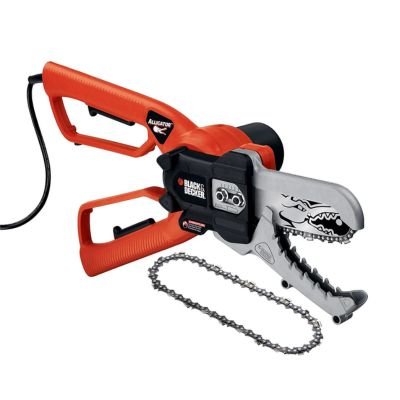
An alligator chainsaw, often called an alligator lopper or jaw-style saw, is a compact cutting tool that uses a moving chainsaw chain enclosed between two opposing jaws. Instead of placing an exposed chain directly against a branch in the same way as a traditional chainsaw, the jaws help hold the material in position while the chain performs the cut.
This design is particularly associated with pruning and cutting relatively small branches and pieces of garden timber. It is different from both a conventional chainsaw and a manual bypass lopper. The cutting action is powered, while the jaw structure provides a degree of control around the material being cut.
Models from established manufacturers such as BLACK+DECKER, WORX and other recognised power-tool brands can vary substantially in motor configuration, cutting capacity, weight, power source, chain speed, safety systems and included accessories. Buyers should therefore compare the complete specification rather than assuming that two tools with similar-looking designs will perform identically.
A conventional chainsaw is generally intended for more demanding cutting applications and uses an exposed guide bar and chain. An alligator-style tool is usually more compact and is oriented toward pruning, garden maintenance and smaller cutting jobs.
A cordless mini chainsaw normally has a small exposed guide bar, whereas an alligator chainsaw uses a jaw mechanism around the cutting area. Both can be useful for garden work, but their handling characteristics are different.
A mini chainsaw can be convenient for reaching awkward branches and making quick cuts, while a jaw-style design can provide a more enclosed cutting arrangement. Buyers should compare the intended application, cutting capacity, safety controls, battery system and overall ergonomics before choosing between the two.
The most useful way to compare alligator chainsaws is to separate genuinely important specifications from marketing language. A higher number is not automatically better if the tool becomes unnecessarily heavy, difficult to manoeuvre or unsuitable for the type of material you normally cut.
Cutting capacity is one of the most important specifications because it determines the approximate size of branch or timber the tool is designed to handle. Always distinguish between the manufacturer's stated maximum cutting capacity and the diameter you expect to cut regularly.
If most of your garden maintenance involves thin branches, buying a substantially larger and heavier tool may provide little practical benefit. Conversely, regularly attempting to cut material close to or beyond the stated capacity can place unnecessary strain on the cutting system and reduce efficiency.
UK buyers will generally encounter mains-powered and cordless battery-powered options. Each approach has advantages.
A mains-powered alligator chainsaw can be useful when working close to a suitable outdoor electrical supply. It avoids battery charging and can be ready to use whenever required. The main disadvantage is cable management and dependence on access to an appropriate power source.
A cordless model provides greater freedom of movement and can be particularly convenient in larger gardens, allotments or areas where running a cable is impractical. The trade-off is the need to manage battery charge, battery condition and compatibility with the manufacturer's battery platform.
Motor power can help indicate the tool's potential performance, but wattage alone should not determine your purchase. Cutting performance also depends on chain speed, chain condition, cutting capacity, motor design, battery voltage on cordless models and the material being cut.
A powerful motor paired with an appropriate chain can maintain cutting performance under load more effectively than an underpowered system. However, the most useful comparison is whether the complete cutting system is appropriate for your normal workload.
For cordless models, battery voltage should also be interpreted carefully. Voltage is not a direct measurement of cutting performance or runtime. Battery capacity, motor efficiency and operating conditions all affect how long a tool can work between charges.
Chain speed influences how quickly the cutting chain travels through the material. A higher chain speed can contribute to faster cutting, but speed must be considered alongside chain design, motor performance and the type of material being processed.
Fast cutting is not automatically preferable if the tool becomes difficult to control. For garden users, balanced handling and predictable cutting behaviour can be more useful than chasing the highest specification.
The chain is a consumable component and will eventually require sharpening, adjustment or replacement. Before buying, check whether replacement chains are available for the model and whether the manufacturer provides clear maintenance instructions.
The guide-bar arrangement should also be considered. A compact cutting assembly can make the tool easier to handle, while the jaw mechanism determines how the branch is positioned relative to the chain.
Do not ignore replacement-part availability. A low initial purchase cost becomes less attractive if obtaining the correct replacement chain or other wear components is unnecessarily difficult.
Safety should be treated as a primary buying criterion rather than a secondary feature. Although the jaw design can enclose much of the cutting area, an alligator chainsaw still contains a powered moving chain capable of causing serious injury.
Look for clearly described safety controls and follow the manufacturer's instructions for starting, operating, cleaning, maintaining and storing the tool.
A lock-off system helps prevent unintended activation of the motor. This is particularly useful when moving the tool, changing position or preparing to make a cut.
Controls should be intuitive enough that you can operate them without adopting an awkward grip. Ergonomics and safety are closely connected: a tool that is uncomfortable to hold can encourage poor positioning and unnecessary fatigue.
Read the manufacturer's safety instructions to determine the protective equipment appropriate for the task. Depending on the work, this may include eye protection, hearing protection, suitable gloves, sturdy footwear and protective clothing.
Keep bystanders, children and pets away from the working area. Never treat the compact size of an alligator chainsaw as an indication that normal chainsaw safety precautions can be ignored.
Weight becomes increasingly important when pruning for an extended period. A tool that feels manageable for a few cuts can become tiring after repeated use.
Consider not only the advertised weight but also where the weight is concentrated. A heavier cutting head can feel substantially different from a tool with better-balanced weight distribution.
If you are considering a cordless alligator chainsaw, determine whether it belongs to a battery platform you already use. Brands such as BLACK+DECKER, WORX and other major power-tool manufacturers may offer multiple cordless garden tools around their respective battery systems.
Using an existing compatible battery can make a cordless tool more attractive, but buyers should confirm compatibility rather than assuming batteries from different product ranges can be interchanged.
Runtime also depends heavily on workload. Cutting many large branches places a different demand on the battery than occasional light pruning. Manufacturer runtime information should therefore be treated as guidance rather than a guarantee of how long the tool will operate during your particular jobs.
Alligator chainsaws are primarily intended for cutting suitable wood and garden branches within the manufacturer's stated capacity. The exact materials and dimensions the tool can handle should always be checked against its instructions.
Do not use the cutting system for materials it was not designed to process. Metal, masonry, plastic and other non-wood materials can require entirely different cutting systems and may damage the chain or create hazardous conditions.
Fresh branches and dry timber can behave differently during cutting. Green wood can contain significant moisture and may produce a different cutting response from dry, seasoned timber.
For this reason, the same diameter does not necessarily represent the same workload. Branch species, density, moisture content, condition and shape can all influence cutting resistance.
Regular chain maintenance is essential for safe and efficient operation. A blunt or poorly adjusted chain can increase cutting time, make the motor work harder and make the tool less pleasant to use.
A sharp chain should cut efficiently according to the manufacturer's specifications. If cutting becomes noticeably slower or the tool appears to struggle with material it previously handled comfortably, inspect the chain and follow the manufacturer's maintenance procedure.
Do not continue using a damaged chain. Replace or service components according to the manufacturer's instructions.
Correct chain tension is important. A chain that is too loose can create operational and safety problems, while excessive tension can increase wear on the cutting system.
Always use the adjustment procedure specified for the particular model. Different tools can use different chain-tensioning arrangements, so generic adjustment advice should not replace the manufacturer's instructions.
Where the design requires chain lubrication, use the lubricant specified or recommended by the manufacturer. Adequate lubrication helps reduce friction and wear during operation.
Check the relevant oil reservoir and lubrication system before use if the model is equipped with one. Do not assume every compact chainsaw-style tool uses the same lubrication arrangement.
Garden cutting can produce sawdust, wood chips and debris around the cutting head. Cleaning the tool after use can help prevent accumulated debris from interfering with moving components.
A genuinely useful rating should be considered alongside the underlying specifications. Customer ratings can help identify common ownership experiences, but they should not replace technical comparison.
When evaluating a highly rated model, consider the following factors together:
Power is important, but it is only one part of the cutting system. A tool should be selected according to the material, branch diameter, operating frequency and handling requirements.
A heavier tool may appear more substantial, but additional weight can become a disadvantage during repeated pruning. Consider whether you can comfortably hold and control the tool for a complete working session.
If your main task is occasional pruning of small garden branches, paying for a substantially larger cutting system may provide limited practical benefit. Match the tool to your real workload rather than an imagined maximum workload.
A cordless tool advertised as a bare unit may require a compatible battery and charger. Include these components when calculating the true cost of ownership.
Chains and other wear components eventually require attention. Check the manufacturer's support information and replacement-part ecosystem before committing to a particular model.
Customer ratings can be useful, but individual reviewers may use a product for very different purposes. A person cutting occasional small branches may have completely different expectations from someone performing frequent garden maintenance.
When comparing verified customer reviews, look for recurring observations rather than isolated comments. Repeated feedback concerning handling, cutting performance, battery life, chain adjustment or durability can be more informative than a single enthusiastic review.
For an independent buying guide, product specifications and manufacturer documentation should be considered alongside customer feedback. Reviews can reveal practical considerations, while specifications establish the intended capabilities of the product.
Not every premium feature provides equal value. Consider paying more when the upgrade addresses a genuine problem in your intended use.
Conversely, avoid paying extra simply because a specification looks impressive if it does not solve a real requirement.
Some specifications can be difficult to interpret without considering the complete product design. Maximum chain speed, motor wattage or battery voltage should not be treated as standalone indicators of overall quality.
The best tool is the one whose complete specification fits the work. For a small garden, a compact and manageable model can be more useful than an unnecessarily powerful tool. For more demanding cutting, however, it may make sense to move beyond the alligator format altogether and consider a conventional chainsaw designed for the workload.
An alligator chainsaw can be particularly suitable for homeowners who regularly need to prune or cut relatively small branches and want a powered alternative to manual loppers.
An alligator chainsaw is not a universal replacement for every type of chainsaw or garden cutting equipment. If you routinely need to cut large logs, fell trees, process substantial timber or perform demanding forestry work, a properly specified conventional chainsaw may be more appropriate.
For very small branches, a manual bypass lopper may also be faster, quieter and simpler because it requires no battery, electricity, chain maintenance or motor.
The right purchase therefore starts with identifying the job rather than starting with the product category.
For a smaller garden, prioritise manoeuvrability and storage. A compact cordless model may be attractive when you only need to perform occasional pruning and want to avoid managing a power cable.
Consider where you will store the tool, how frequently you expect to use it and whether your existing batteries can be used. If your garden is close to an appropriate electrical supply and you perform longer cutting sessions, a corded model may also make sense.
In a larger garden, mobility becomes more important. A cordless model can reduce cable management, especially when branches are spread across different parts of the property.
Battery capacity should be considered in relation to the size of the workload. If you expect to undertake substantial pruning in one session, having a suitable battery capacity or compatible spare battery can be more practical than relying on a small battery.
Tree pruning requires particular care. Before cutting, identify the branch, understand where it is under tension and make sure you have a stable working position.
Do not overreach or use the tool from an unstable ladder or other unsafe position. If a branch is large, high, structurally significant or difficult to control, professional tree-care assistance may be more appropriate.
Never assume that a compact tool makes high-level tree work safe. Working at height introduces additional hazards that should be assessed separately from the cutting tool itself.
Branches can store mechanical energy when bent, supported or trapped by other material. Cutting a branch under tension can cause it to move unexpectedly as the load is released.
For this reason, avoid cutting material when you do not understand how it is supported. Keep your body away from potential movement paths and follow the manufacturer's safety instructions. For difficult or hazardous cuts, use an appropriately trained professional.
Noise and vibration can influence how pleasant a tool is to use, particularly during extended garden maintenance. Electric tools can differ significantly in perceived vibration depending on motor design, chain condition, cutting load and construction.
A sharp and correctly maintained chain can contribute to smoother operation. Excessive vibration, unusual noise or unexpected movement should not be ignored; stop using the tool and inspect it according to the manufacturer's instructions.
If two models appear similar, use a structured comparison rather than relying on appearance or headline ratings.
The purchase price is only one component of ownership cost. A cordless tool may require a battery and charger, while both corded and cordless models can eventually require replacement chains or other consumables.
Consider the complete package:
This approach can reveal why a slightly more expensive tool may sometimes represent better long-term value, particularly if it fits an existing battery ecosystem or has readily available replacement components.
Product listings can contain multiple configurations of the same or similar model. Before purchasing, verify the exact model designation and the contents of the package.
This is especially important when comparing offers from different retailers, because apparently identical listings can sometimes represent different kits or bundles.
Established power-tool brands can be useful starting points for comparison because they often have broader product ranges and established replacement-part ecosystems. BLACK+DECKER is strongly associated with compact garden power tools, while WORX offers a broad range of cordless and corded outdoor equipment. Other established manufacturers may also offer suitable pruning equipment depending on the exact category and current UK product range.
Brand reputation should not replace model-level comparison. A recognised manufacturer can produce different tools for different workloads, and the most appropriate model still depends on cutting capacity, ergonomics, power source and maintenance requirements.
For occasional users, simplicity is usually more valuable than an extensive list of premium specifications. Look for a manageable tool with sufficient cutting capacity, straightforward controls, appropriate safety features and readily available consumables.
If you already own compatible cordless garden equipment, a model using the same battery platform may offer practical advantages. If you do not own batteries and only use the tool occasionally, compare the complete kit price rather than the bare-tool price.
Frequent users should pay greater attention to ergonomics, chain maintenance, battery capacity or continuous mains operation, depending on the chosen power source. Durability and availability of replacement components also become more important when the tool will receive regular use.
A tool that is easy to clean, inspect and maintain can be preferable to one with slig